Mineral vs Chemical Sunscreen: Which Is Better for Your Skin?
The sunscreen debate creates more confusion than almost any other skincare topic. Mineral sunscreens use zinc oxide and titanium dioxide to physically block UV rays. Chemical sunscreens use organic filters like avobenzone and oxybenzone to absorb UV radiation. Both protect your skin — but they work differently, feel differently, and have different safety profiles. This guide compares them with clinical evidence so you can make an informed choice.
⚡ TL;DR
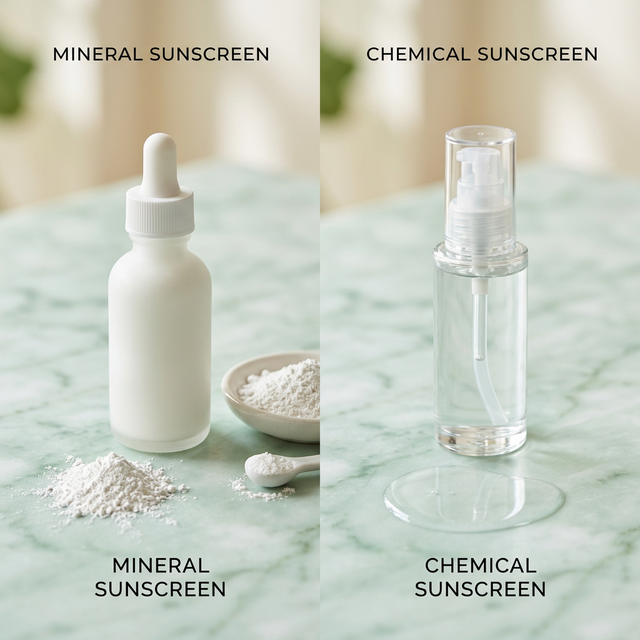
Mineral (zinc oxide/titanium dioxide): sits on skin, reflects UV, FDA GRASE, immediate protection, best for sensitive skin, reef-safe. Chemical (avobenzone/oxybenzone): absorbs into skin, converts UV to heat, needs 15-min wait, more cosmetically elegant, but FDA requesting more safety data. Best choice: mineral for sensitive/reactive skin; chemical or hybrid for daily cosmetic use. Both are better than no sunscreen.
📖 What Is Sunscreen?
Sunscreen is a topical product that protects skin from ultraviolet (UV) radiation — the primary cause of skin cancer, premature aging, and hyperpigmentation. According to the American Academy of Dermatology (AAD), UV radiation causes approximately 80% of visible skin aging. Sunscreens are classified by their active filters into two categories: mineral (inorganic physical blockers) and chemical (organic UV absorbers). Both types must pass the same FDA SPF testing standards to receive their rating.
How Each Type Works
🛡️ Mineral Sunscreen
Uses zinc oxide and/or titanium dioxide. These mineral particles sit on the skin surface and physically scatter, reflect, and absorb UV photons before they penetrate into the epidermis.
- Works immediately on application
- Does not absorb into bloodstream
- FDA classified as GRASE (Generally Recognized as Safe and Effective)
- Broad-spectrum when zinc oxide ≥5%
☀️ Chemical Sunscreen
Uses organic molecules like avobenzone, oxybenzone, octisalate, homosalate. These absorb UV photons and convert them to heat, which is released from the skin.
- Needs 15-20 minutes to activate
- FDA has requested more safety data (2019)
- More cosmetically elegant, no white cast
- Degrades faster under UV exposure
Head-to-Head Comparison
| Factor | Mineral | Chemical |
|---|---|---|
| Active ingredients | Zinc oxide, titanium dioxide | Avobenzone, oxybenzone, octisalate, homosalate |
| FDA safety status | ✅ GRASE (safe & effective) | ⚠️ More data requested |
| Absorption into skin | Stays on surface | Penetrates and absorbs into bloodstream |
| Activation time | Immediate | 15-20 minutes |
| White cast | Yes (reduced in tinted/micronized) | No |
| Sensitive skin | ✅ Best choice — lowest irritation | ⚠️ Can trigger sensitivity in some |
| Reef safety | ✅ Reef-safe (non-nano) | ❌ Oxybenzone causes coral bleaching |
| Photostability | Highly stable, doesn't degrade | Degrades under UV, needs stabilizers |
The Safety Question: What the Research Says
According to a 2020 study published in JAMA (DOI: 10.1001/jama.2019.20747), six chemical sunscreen active ingredients were absorbed into the bloodstream at levels exceeding the FDA's 0.5 ng/mL threshold after a single application. Oxybenzone reached concentrations 188 times this threshold.
According to the FDA's 2019 proposed sunscreen rule, only two active ingredients — zinc oxide and titanium dioxide — are classified as GRASE. The remaining 12 chemical filters require additional safety testing. According to Dr. Janet Woodcock (former FDA Commissioner), "the absorption findings do not mean these ingredients are unsafe — they mean we need more data."
According to the AAD position statement, dermatologists universally agree: any sunscreen is better than no sunscreen. The best sunscreen is the one you actually apply consistently.
Check what UV filters are in your sunscreen
SkinGuard scans your sunscreen ingredient list and instantly identifies whether it's mineral, chemical, or hybrid. It flags oxybenzone, checks for reef-unsafe ingredients, and verifies SPF claims against active ingredient concentrations.
Scan Your Sunscreen Free →Which Type Is Best for Your Skin?
Sensitive / Rosacea / Eczema Skin
Choose mineral. Zinc oxide is anti-inflammatory and sits on the skin surface without penetrating. It causes the fewest allergic reactions of all UV filters. See our sensitive skin routine.
Oily / Acne-Prone Skin
Choose lightweight chemical or hybrid. Mineral sunscreens can feel heavy on oily skin. Chemical formulas are typically lighter. Look for oil-free, non-comedogenic formulations. See our oily skin routine.
Dark Skin Tones
Choose tinted mineral or chemical. Traditional mineral sunscreen leaves white cast on dark skin. Tinted mineral formulas contain iron oxides that match skin tone and provide additional visible light protection. Chemical sunscreens are transparent.
Children / Pregnancy
Choose mineral. According to the AAD and American Academy of Pediatrics, mineral sunscreens are preferred for children under 6 months and during pregnancy due to the absence of systemic absorption.
Anti-Aging (30s+)
Either works — just apply daily. According to the 2013 Annals of Internal Medicine study, daily sunscreen users showed 24% less aging regardless of type. For a complete anti-aging routine, see our 30s skincare guide.
Find the safest sunscreen for your skin type
SkinGuard's database of 28,705+ substances identifies UV filter types, flags potentially concerning ingredients, and checks if your sunscreen formula includes stabilizers for long-lasting protection.
Download SkinGuard Free →Frequently Asked Questions
Is chemical sunscreen safe?+
The FDA has requested more safety data on chemical UV filters like oxybenzone and avobenzone, but has not banned them. A 2020 JAMA study found chemical filters absorb into the bloodstream, though clinical significance is unknown. If concerned, choose mineral sunscreen (zinc oxide/titanium dioxide), which are FDA GRASE.
Which sunscreen is better for sensitive skin?+
Mineral sunscreen (zinc oxide) is better for sensitive, eczema-prone, and rosacea skin. It sits on top of skin without penetrating, causes fewer allergic reactions, and provides immediate protection without a wait time.
Does mineral sunscreen leave a white cast?+
Traditional mineral sunscreen can leave a white cast, especially on darker skin tones. Modern formulations use micronized or nano zinc oxide to reduce this significantly. Tinted mineral sunscreens eliminate white cast entirely while adding visible light protection.
Can I mix mineral and chemical sunscreen?+
Hybrid sunscreens that combine mineral and chemical filters exist and are effective. However, mixing two separate products (one mineral, one chemical) is not recommended — they can destabilize each other. Pick one type and stick with it.
Is chemical sunscreen bad for coral reefs?+
Oxybenzone and octinoxate are banned in Hawaii and Palau for reef toxicity. According to a 2016 study in Archives of Environmental Contamination and Toxicology, oxybenzone causes coral bleaching at concentrations as low as 62 parts per trillion. Mineral sunscreens (non-nano) are considered reef-safe.
Related Articles
⚕️ This article is for educational purposes only and does not replace professional dermatological advice. Consult a dermatologist for personalized sun protection recommendations.