Is Your Skincare Safe? How to Check Any Product (2026 Guide)
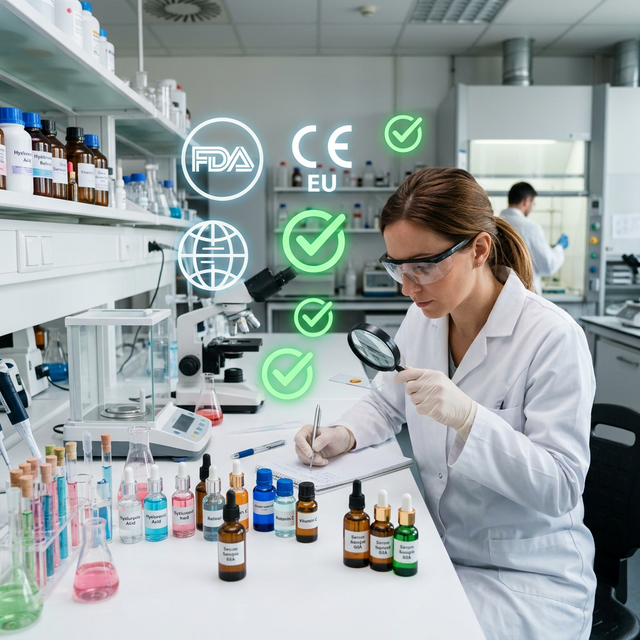
⚡ TL;DR
Most skincare products are safe — but "safe" means different things in different countries. According to the EU Cosmetics Regulation, 1,600+ substances are banned in European cosmetics that remain legal in US products. The FDA does not require pre-market safety approval for cosmetics. This guide shows you how to check your products against global safety databases, identify red-flag ingredients, and separate evidence from hype.
📖 What Does "Safe Skincare" Mean?
According to toxicology principles, "safe" is not binary — it's a function of hazard × exposure. The dose makes the poison. Water is fatal at extreme doses; retinol is beneficial at 0.025% but irritating at 1%. A "safe" skincare product contains ingredients at concentrations that have been assessed for the intended use pattern (frequency, duration, body area) by credible regulatory or scientific bodies.
The Regulatory Landscape: EU vs US vs Others
According to the European Commission, the EU Cosmetics Regulation (EC 1223/2009) is the world's most comprehensive cosmetic safety framework. It requires:
- Pre-market safety assessment by a qualified safety assessor
- Mandatory adverse event reporting (CPNP system)
- 1,600+ banned substances listed in Annex II
- Strict concentration limits for another 300+ restricted substances (Annex III)
According to the FDA, the US approach is fundamentally different. Under the Federal FD&C Act:
- Cosmetic ingredients do not require FDA pre-market approval
- Only 11 substances are banned or restricted at the federal level
- The Modernization of Cosmetics Regulation Act (MoCRA, 2022) added mandatory adverse event reporting but still does not require pre-market ingredient approval
- According to the Personal Care Products Council, the industry relies primarily on CIR (Cosmetic Ingredient Review) panel self-regulation
| Regulatory Feature | EU | US (Post-MoCRA) | Japan |
|---|---|---|---|
| Pre-market approval | ✅ Required | ❌ Not required | ✅ Quasi-drugs |
| Banned substances | 1,600+ | ~11 | ~30 |
| Safety assessor requirement | ✅ Mandatory | ❌ | ⚠️ For quasi-drugs |
| Adverse event reporting | ✅ Mandatory | ✅ (since 2023) | ✅ Mandatory |
| Ingredient transparency | ✅ INCI required | ✅ INCI required | ✅ Required |
Ingredients Banned in the EU but Legal in the US
According to the EU Cosmetics Regulation Annex II, the following common ingredients are banned or restricted in Europe but remain legal in US cosmetics:
| Ingredient | EU Status | US Status | Concern |
|---|---|---|---|
| Formaldehyde (>0.1%) | 🔴 Banned | ⚠️ Allowed | Carcinogen (IARC Group 1) |
| Hydroquinone (OTC) | 🔴 Banned | ⚠️ Allowed (2%) | Skin sensitization, ochronosis risk |
| Isopropylparaben | 🔴 Banned | ⚠️ Allowed | Endocrine disruption concern |
| Triclosan (in leave-on) | 🔴 Banned | ⚠️ Limited | Endocrine disruption, resistance |
| Oxybenzone (high %) | ⚠️ Restricted (6%) | ⚠️ Allowed (6%) | Coral reef damage, endocrine concerns (DOI: 10.1007/s00204-019-02612-x) |
Important context: According to cosmetic chemist Kindof Stephen, "Banned in the EU" doesn't always mean "dangerous." Some EU bans are precautionary, based on the EU's stronger interpretation of the precautionary principle, not on documented human harm.
How to Check If Your Products Are Safe
According to dermatologist Dr. Hadley King, the most reliable approach combines database cross-referencing with awareness of your individual risk factors:
- Use a credible ingredient checker: Apps like SkinGuard cross-reference against 28,705 cosmetic substances from CosIng, CIR, and peer-reviewed studies. For a comparison of tools, see our Ingredient Checker Guide
- Focus on the first 5-10 ingredients: According to INCI listing rules, ingredients are listed by concentration (highest first above 1%). The first 5-10 ingredients make up the bulk of the product
- Check for your specific triggers: If you have sensitive skin, focus on fragrance and common irritants. If acne-prone, focus on comedogenic ingredients. See our Pore-Clogging Ingredients List
- Learn to read INCI: Understanding the basics of ingredient naming lets you spot red flags quickly. Our How to Read Skincare Labels guide covers the essentials
The "Clean Beauty" Paradox
According to the Environmental Working Group, the "clean beauty" market reached $11.6 billion in 2023 — yet the term has no regulatory definition. According to cosmetic chemist Perry Romanowski, "Clean beauty is marketing, not science. Every brand defines it differently."
According to a 2022 study in the International Journal of Cosmetic Science (DOI: 10.1111/ics.12803), the "clean" trend has created unintended safety issues:
- Preservative removal: Replacing effective preservatives (parabens) with "natural" alternatives can increase microbial contamination risk — a genuine safety concern
- Natural ≠ safe: Poison ivy is natural. Essential oils cause contact dermatitis. Tretinoin (the most proven anti-aging ingredient) is synthetic
- Fear-based formulation: According to cosmetic scientist Michelle Wong, "When brands remove effective ingredients because of internet fear, customers get worse products at higher prices"
When to Actually Worry About Safety
According to board-certified dermatologist Dr. Ranella Hirsch, genuine safety concerns are narrower than social media suggests:
- Pregnancy: Retinoids (tretinoin, adapalene, tazarotene) are contraindicated in pregnancy. According to the ACOG, oral retinoids are Category X. Topical retinoids are Category C (risk not ruled out). SkinGuard flags these automatically when pregnancy mode is enabled
- Documented allergens: If you have confirmed contact allergies (patch-test verified), avoiding those specific allergens is critical. See our Fragrance in Skincare guide
- Damaged skin barrier: According to Levin et al. (2019) in Journal of Clinical and Aesthetic Dermatology (DOI: 10.36849/JDD.2019.3166), compromised skin barriers increase absorption of all topical ingredients — including potential irritants
- Cumulative exposure: According to the EWG, using 9+ personal care products daily means exposure to 126+ unique ingredients. While each product may be safe individually, cumulative effects are less studied
Frequently Asked Questions
How do I know if my skincare is safe?
Cross-reference ingredients against the EU CosIng database (most comprehensive), check EWG Skin Deep ratings, or use an ingredient scanner app like SkinGuard that covers 28,705 verified substances. Focus on ingredients in the top 10 positions.
Are US skincare products safe?
The US cosmetics industry is largely self-regulated — the FDA does not require pre-market approval. The EU has banned 1,600+ substances still legal in US cosmetics. Most US products are safe, but fewer ingredients are proactively screened.
What skincare ingredients are banned in Europe?
The EU has banned over 1,600 cosmetic ingredients including formaldehyde (above 0.1%), certain parabens, hydroquinone in OTC products, and some UV filters.
Is "clean beauty" actually safer?
Not necessarily. "Clean beauty" is an unregulated marketing term. Some "clean" products replace effective preservatives with less proven alternatives, which can lead to microbial contamination — a real safety risk.
What does "dermatologist tested" mean?
Very little. The claim only means a dermatologist was involved in some testing — it doesn't specify what was tested, the sample size, or the results. It is not a guarantee of safety or efficacy.
📚 References
- European Commission. (2009). Regulation (EC) No 1223/2009 on cosmetic products. EU Cosmetics Regulation
- Krause, M., et al. (2019). UV filter safety review. Archives of Toxicology, 93(12). DOI: 10.1007/s00204-019-02612-x
- Burnett, C. L., et al. (2022). Clean beauty vs evidence-based formulation. International Journal of Cosmetic Science, 44(5). DOI: 10.1111/ics.12803
- Levin, J., et al. (2019). Atopic dermatitis and the skin barrier. Journal of Drugs in Dermatology, 18(1). DOI: 10.36849/JDD.2019.3166
⚕️ Medical Disclaimer: This article is for educational purposes only. Ingredient safety depends on concentration, formulation, individual sensitivity, and regulatory context. This is not a substitute for professional medical advice.