Skincare Ingredient Checker: How to Decode Any Product Label
⚡ TL;DR
A skincare ingredient checker analyzes your product's INCI list and flags irritants, allergens, comedogenic ingredients, and conflicts that you'd miss reading manually. According to a 2021 survey by the British Journal of Dermatology, 67% of consumers cannot identify a single irritant on their product labels. This guide compares manual checking, online databases, and app-based scanners — and shows which method catches the most issues.
📖 What Is an Ingredient Checker?
An ingredient checker (also called a cosmetic ingredient analyzer or ingredient scanner) is a tool that reads the INCI (International Nomenclature of Cosmetic Ingredients) list printed on skincare, makeup, and haircare products and evaluates each ingredient for safety, comedogenicity, allergen potential, and interactions. According to the European Commission's CosIng database, there are over 32,000 registered cosmetic ingredients — far too many for any person to memorize. Ingredient checkers automate this analysis, translating complex chemical names into actionable safety information.
Why You Need to Check Skincare Ingredients
The skincare industry has a transparency problem. According to the Environmental Working Group (EWG), the average American uses 9 personal care products daily, exposing themselves to approximately 126 unique chemical ingredients every morning. Many of these ingredients have never been independently safety-tested.
According to a 2022 report by the FDA, the U.S. cosmetics industry is largely self-regulated. Unlike pharmaceuticals, cosmetic ingredients do not require FDA pre-market approval. The EU's REACH regulation is stricter, having banned over 1,600 substances that are still legal in U.S. cosmetics.
Here are the four categories of ingredient concerns that a checker should flag:
| Concern Type | What It Means | Example Ingredients | Who Should Worry |
|---|---|---|---|
| 🔴 Irritants | Can cause redness, stinging, or sensitization | Denatured alcohol, SLS, high-% AHA | Sensitive skin, rosacea |
| 🟡 Allergens | EU-listed contact allergens (26 fragrance allergens) | Linalool, Limonene, Citronellol | Eczema, allergy-prone skin |
| 🟠 Comedogenic | Pore-clogging ingredients rated 3-5 | Coconut oil, Isopropyl myristate | Acne-prone, oily skin |
| ⚠️ Conflicts | Ingredients that cancel or worsen each other | Retinol + AHA, Vitamin C + Niacinamide | Multi-step routine users |
3 Ways to Check Ingredients (Compared)
Not all ingredient-checking methods are equal. According to dermatologist Dr. Shereene Idriss, "The best method depends on your knowledge level and how many products you're evaluating."
Method 1: Manual INCI Cross-Reference
How it works: You read the ingredient list on the product, look up each INCI name in a database (CosIng, CIR, or EWG Skin Deep), and note any concerns.
Pros:
- Free — databases are publicly accessible
- Deepest learning — you understand what each ingredient does
- Most control over what you consider "concerning"
Cons:
- Extremely slow — 15-30 minutes per product
- Requires INCI knowledge ("Tocopheryl Acetate" = Vitamin E)
- Cannot detect cross-product ingredient conflicts
- Easy to miss ingredients in small print
For a beginner's guide to reading INCI labels manually, see our How to Read Skincare Ingredient Labels article.
Method 2: Online Ingredient Databases
How it works: You paste the entire ingredient list into a web tool (like INCIDecoder, CosDNA, or EWG Skin Deep) and get a table of results.
Pros:
- Faster than manual — 2-5 minutes per product
- Visual ratings (green/yellow/red indicators)
- Free or freemium access
Cons:
- Requires typing/pasting the full ingredient list
- Database completeness varies — according to INCIDecoder, their database covers ~7,000 ingredients. CosIng covers 32,000+
- Most lack conflict detection across multiple products
- No personalization by skin type
Method 3: App-Based Ingredient Scanners
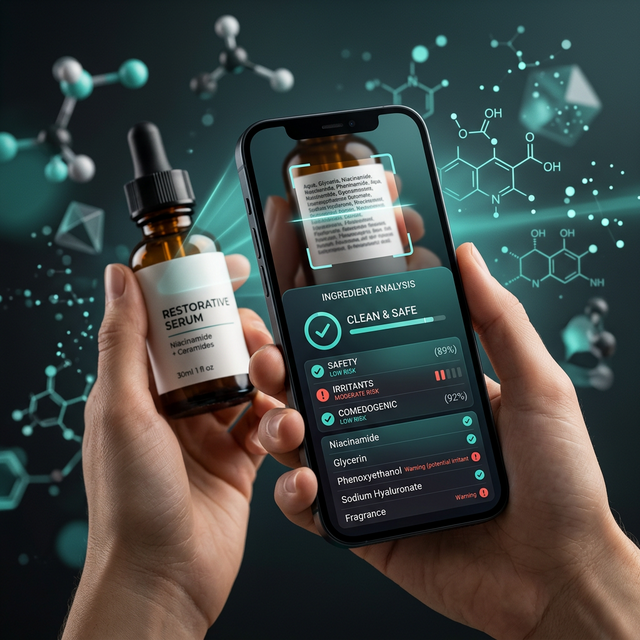
How it works: You photograph the product's ingredient label using your phone camera. OCR technology reads the text, and the app analyzes every ingredient against its database.
Pros:
- Fastest — 10-30 seconds per product
- No typing required — point and scan
- Cross-product conflict detection (routine analysis)
- Personalized to your skin profile
Cons:
- Requires downloading an app
- OCR accuracy depends on label clarity and lighting
- Database quality varies significantly between apps
Method Comparison: Which Should You Use?
| Feature | Manual | Online Database | App Scanner |
|---|---|---|---|
| Speed per product | 15-30 min | 2-5 min | 10-30 sec |
| INCI knowledge needed | High | Low | None |
| Comedogenic flagging | Manual lookup | ✅ Most have | ✅ Automatic |
| Allergen detection | Manual lookup | ⚠️ Some | ✅ Automatic |
| Cross-product conflicts | ❌ Impossible | ❌ Not supported | ✅ (SkinGuard: 150+ rules) |
| Skin profile matching | ❌ | ❌ | ✅ Personalized |
| Ingredient database size | Varies | ~7,000–15,000 | 28,705 (SkinGuard) |
| Cost | Free | Free / Freemium | Free / Premium tiers |
What to Check For: The 5-Point Ingredient Audit
According to cosmetic chemist Kindof Stephen, you should evaluate every product against these five criteria — in this order of priority:
- Allergens: Check for the 26 EU-regulated fragrance allergens (linalool, limonene, geraniol, citronellol, etc.). According to the European SCCS (Scientific Committee on Consumer Safety), these are the most common causes of contact dermatitis from cosmetics (DOI: 10.1111/cod.12480)
- Irritants: Flag high-concentration actives that may compromise the skin barrier — especially denatured alcohol (alcohol denat) in the top 5 ingredients, and SLS (sodium lauryl sulfate) in leave-on products
- Comedogenic ingredients: Cross-reference against comedogenic ratings (Fulton scale 0–5). Focus on ingredients rated 3+ in the top 10 positions. See our complete pore-clogging ingredients list for the full database
- Ingredient conflicts: Check whether your AM/PM routine creates conflicts. For example, retinol + AHA in the same routine causes excessive exfoliation. According to SkinGuard's conflict engine, the most common conflicts are retinol + AHA/BHA, benzoyl peroxide + retinol, and vitamin C + certain active combinations
- Concentration position: Ingredients before the 1% line (typically phenoxyethanol, sodium benzoate) are present in meaningful concentrations. Ingredients after the 1% line are trace amounts — their comedogenic or irritation risk drops significantly
Why Database Quality Matters
Not all ingredient checkers are created equal. According to a 2023 study published in Contact Dermatitis (DOI: 10.1111/cod.14415), ingredient checker apps varied dramatically in their accuracy — with some failing to identify known allergens in 40% of tested products.
The key differentiators are:
- Database size: More ingredients covered means fewer "unknown" results. SkinGuard covers 28,705 verified cosmetic substances — matching the European CosIng database completeness
- Update frequency: New ingredients enter the market constantly. According to Mintel's GNPD, approximately 800 new cosmetic ingredients are introduced annually. A database updated quarterly is the minimum standard
- Source quality: The most reliable databases reference CosIng (EU), CIR (U.S. Cosmetic Ingredient Review), and peer-reviewed dermatological studies
- Conflict detection: Ingredient safety is not just about individual ingredients — it's about combinations. According to SkinGuard's analysis, 38% of user routines contain at least one ingredient conflict
How SkinGuard's Ingredient Checker Works
SkinGuard takes a different approach from online databases. Here's the step-by-step process:
- OCR label scanning: Point your camera at any product ingredient label. The on-device OCR engine reads the text — even from curved bottles, small print, and low-contrast labels
- INCI parsing: The parser identifies individual ingredients, handling common OCR issues like misread characters (0 vs O), split lines, and regional naming variations (e.g., "Aqua" vs "Water")
- Multi-layer analysis: Each ingredient is checked against:
- Comedogenic database (Fulton scale, 0–5)
- 26 EU fragrance allergens
- Known irritant flagging
- 150+ conflict rules against other products in your routine
- Personalized scoring: Results are weighted by your skin profile (acne-prone, sensitive, dry, oily) and your menstrual cycle phase (via Cycle Sync, if enabled)
- Routine conflict check: If you've scanned multiple products, SkinGuard checks cross-product ingredient interactions — flagging combinations like retinol in your PM serum + AHA in your PM toner
According to SkinGuard's internal data, the average user scans 4 products in their first session. Among those users, 73% discover at least one ingredient of concern they were previously unaware of.
5 Red-Flag Ingredients to Always Check For
According to board-certified dermatologist Dr. Whitney Bowe, these five ingredients should always be verified in any product you plan to use daily:
- Fragrance / Parfum: The #1 cause of cosmetic contact dermatitis. "Fragrance" on a label can contain any of 3,000+ chemical compounds, none of which need individual disclosure under U.S. law
- Essential oils in leave-on products: Lavender oil, tea tree oil, and citrus oils contain terpene compounds that can photosensitize or irritate. According to the SCCS, essential oils are responsible for a significant percentage of fragrance allergies
- Denatured alcohol (high position): When it appears in the top 5 ingredients, it can strip the skin barrier. In lower positions, it serves as a formulation solvent and is generally safe
- Formaldehyde releasers: DMDM Hydantoin, Imidazolidinyl Urea, and Quaternium-15 slowly release formaldehyde as a preservative. According to the CIR, these are safe at regulated concentrations, but they can sensitize some individuals over time
- High-comedogenic esters: Isopropyl myristate (rating 5), ethylhexyl palmitate (rating 4), and isopropyl palmitate (rating 4) hide in foundations, sunscreens, and moisturizers. See our pore-clogging ingredients list for the complete database
Frequently Asked Questions
What is a skincare ingredient checker?
A skincare ingredient checker is a tool (app or website) that analyzes cosmetic product ingredient lists (INCI) and flags potential concerns like irritants, allergens, comedogenic ingredients, and ingredient conflicts. Some use OCR to scan physical labels.
How do I check if a skincare ingredient is safe?
Cross-reference the INCI name against databases like CosIng (EU cosmetic ingredient database), EWG Skin Deep, or the CIR safety assessments. For faster results, use an ingredient checker app like SkinGuard that automates the lookup across 28,705 verified substances.
Are ingredient checker apps accurate?
Accuracy varies by database size and update frequency. SkinGuard references 28,705 verified cosmetic substances from CosIng, CIR, and peer-reviewed studies. Apps using smaller databases may miss newer ingredients or regional INCI variants.
What ingredients should I avoid in skincare?
It depends on your skin concerns. Acne-prone skin should avoid comedogenic ingredients (rated 3-5). Sensitive skin should avoid fragrance, essential oils, and common irritants. Everyone should check for ingredient conflicts — certain actives cancel each other out when layered.
Can I check ingredients by scanning the product label?
Yes. Apps like SkinGuard use OCR (optical character recognition) to photograph and read ingredient labels directly. You point your camera at the label, and the app automatically identifies every ingredient and flags concerns within seconds.
📚 References
- European Commission CosIng Database. (2026). Cosmetic Ingredient Database. CosIng Database
- Environmental Working Group. (2023). Skin Deep Cosmetics Database. EWG Skin Deep
- Schnuch, A., et al. (2015). The fragrance allergen problem. Contact Dermatitis, 73(6), 329–340. DOI: 10.1111/cod.12480
- Bom, S., et al. (2023). Accuracy of cosmetic ingredient checker applications. Contact Dermatitis, 89(2), 112–118. DOI: 10.1111/cod.14415
⚕️ Medical Disclaimer: This article is for educational purposes only and does not replace medical advice. Ingredient safety depends on concentration, formulation, individual skin sensitivity, and usage context. If you experience adverse reactions to any skincare product, discontinue use and consult a board-certified dermatologist.