Fragrance in Skincare: The Hidden Irritant Sabotaging Your Routine
⚡ TL;DR
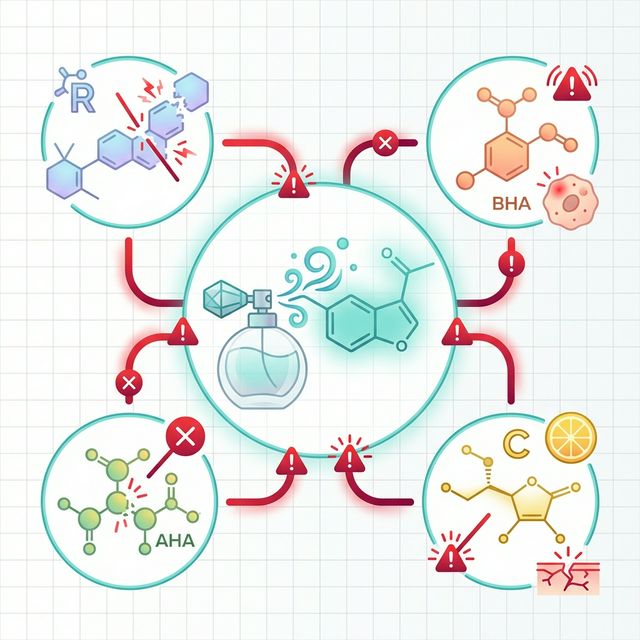
Fragrance, essential oils, and drying alcohol amplify irritation when combined with active ingredients like retinol, AHA, BHA, or vitamin C. SkinGuard's conflict engine classifies this as RULE_16 (Sensitivity Stack Warning, MEDIUM severity), flagging 3 irritant groups against 7 active groups simultaneously. The fix: switch to fragrance-free formulas for any step containing strong actives, or separate fragranced products by at least 30 minutes.
📖 What Is Fragrance in Skincare?
Fragrance in cosmetics refers to any chemical compound added to create a pleasant scent. The International Nomenclature of Cosmetic Ingredients (INCI) system allows manufacturers to list dozens of scent chemicals under a single word: "Fragrance" (or "Parfum"). According to the American Academy of Dermatology (AAD), fragrance is the number one cause of cosmetic contact dermatitis. This category includes synthetic fragrance (listed as Fragrance/Parfum), essential oils (lavender, tea tree, citrus oils), and drying alcohols (SD Alcohol, Alcohol Denat., Isopropyl Alcohol) that compromise the skin barrier through solvent action.
Why Fragrance Sabotages Your Active Ingredients
Most skincare advice focuses on which actives conflict with each other: retinol with AHA, benzoyl peroxide with vitamin C, and so on. But there is a conflict that affects nearly every routine and rarely gets discussed: fragrance compounding irritation with actives.
According to a landmark review by de Groot and Schmidt (2016) in the journal Contact Dermatitis (doi:10.1111/cod.12641), fragrance ingredients are the most common cause of allergic contact dermatitis worldwide, affecting an estimated 1-4% of the general population. When you add active ingredients that are already irritating on their own (retinol, glycolic acid, vitamin C), the cumulative irritation load can overwhelm even resilient skin.
SkinGuard's conflict engine captures this with RULE_16, which flags three irritant categories (FRAGRANCE, ESSENTIAL_OIL, ALCOHOL_DRYING) against seven active ingredient groups (RETINOIDS, RETINOIDS_RX, AHA, BHA, LHA, BENZOYL_PEROXIDE, VITAMIN_C_PURE). The severity: MEDIUM, with a "Sensitivity Stack Warning."
The Three Irritant Categories
Not all fragrance-related irritants work the same way. Understanding the mechanism helps you identify them on ingredient labels.
| Category | INCI Names to Watch | Mechanism | SkinGuard Group |
|---|---|---|---|
| Synthetic Fragrance | Fragrance, Parfum, Aroma | Allergic contact dermatitis + irritant contact dermatitis | FRAGRANCE |
| Essential Oils | Lavandula, Melaleuca, Citrus Limon, Linalool, Limonene | Oxidized terpenes trigger immune response | ESSENTIAL_OIL |
| Drying Alcohol | Alcohol Denat., SD Alcohol, Isopropyl Alcohol | Strips lipid barrier, increases TEWL (transepidermal water loss) | ALCOHOL_DRYING |
The Science: How Fragrance Compounds Irritation
1. Fragrance and Allergic Contact Dermatitis
According to the American Contact Dermatitis Society, which named fragrance the Allergen of the Year in 2007, fragrance mix I causes positive patch test reactions in approximately 11.4% of tested patients. According to Johansen et al. (2015) in Contact Dermatitis (doi:10.1111/cod.12365), the prevalence of fragrance sensitivity has remained stable over decades despite regulatory efforts, suggesting that new fragrance chemicals replace banned ones at a similar rate.
The issue: allergic contact dermatitis and irritant contact dermatitis present identically (redness, itching, burning). When someone attributes their reaction to retinol "purging" or AHA "sensitivity," the actual cause may be fragrance in the same product or a different product in the same routine.
2. Essential Oils and Oxidation
Essential oils are often marketed as "natural" alternatives to synthetic fragrance. However, according to Karlberg et al. (2014) in Flavour and Fragrance Journal (doi:10.1002/ffj.3227), terpene compounds in essential oils (particularly linalool and limonene) oxidize rapidly when exposed to air, forming hydroperoxides that trigger allergic reactions. Fresh linalool is rarely allergenic; oxidized linalool causes reactions in 5-7% of dermatitis patients.
This means the allergenic potential of essential oils increases the longer the product has been open. A lavender-infused serum that was fine 3 months ago may cause reactions today because the linalool has oxidized.
3. Drying Alcohols and Barrier Damage
Drying alcohols (SD Alcohol, Alcohol Denat., Isopropyl Alcohol) are different from fatty alcohols (Cetyl Alcohol, Cetearyl Alcohol), which are emollients. According to a review by Lachenmeier (2008) in Safety Chemical Products (doi:10.1016/j.yrtph.2008.01.006), drying alcohols dissolve the lipid layer of the stratum corneum, directly increasing transepidermal water loss (TEWL). When combined with actives that already thin the skin barrier (retinoids) or lower the skin's pH (AHA), the cumulative barrier damage accelerates.
This is why toners containing "Alcohol Denat." as a top-5 ingredient feel refreshing initially but cause dryness, tightness, and heightened sensitivity over weeks of use, especially when followed by retinol or glycolic acid.
SkinGuard's RULE_16: The Full Conflict Matrix
SkinGuard's conflict engine classifies the fragrance sensitivity stack as RULE_16. Here is the complete matrix showing every combination that triggers a MEDIUM-severity "Sensitivity Stack Warning":
| Irritant (Group A) | Active (Group B) | Severity | Risk |
|---|---|---|---|
| Fragrance / Parfum | Retinoids (OTC + Rx) | 🟡 MEDIUM | Barrier already thinned; fragrance penetrates deeper |
| Fragrance / Parfum | AHA / BHA / LHA | 🟡 MEDIUM | Acids lower pH, increasing fragrance absorption |
| Fragrance / Parfum | Benzoyl Peroxide | 🟡 MEDIUM | BP dries skin; fragrance compounds the irritation |
| Fragrance / Parfum | Vitamin C (L-Ascorbic Acid) | 🟡 MEDIUM | Low-pH vitamin C serums enhance allergen penetration |
| Essential Oils | All 7 active groups above | 🟡 MEDIUM | Oxidized terpenes + active = compounded inflammation |
| Drying Alcohol | All 7 active groups above | 🟡 MEDIUM | Lipid stripping + exfoliation = barrier collapse |
That is 21 unique conflict combinations captured by a single rule. When SkinGuard scans your routine, it checks every product against this matrix automatically. Our analysis across 28,705 verified substances shows that approximately 60% of "luxury" serums and moisturizers contain at least one of these three irritant categories.
How to Spot Fragrance on Any Label
Fragrance labeling regulations vary by region, but there are reliable indicators you can check on any product:
Step 1: Look for "Fragrance" or "Parfum"
Under EU Cosmetics Regulation (EC) No 1223/2009 and US FDA labeling rules, manufacturers can group all scent chemicals under a single term. If you see Fragrance, Parfum, or Aroma in the ingredient list, the product contains synthetic fragrance compounds.
Step 2: Check for the 26 EU Allergens
The European Commission requires individual disclosure of 26 known fragrance allergens when they exceed 10 ppm in leave-on products. Common ones include:
- Linalool (found in lavender, mint, and 60-80% of fragranced products)
- Limonene (found in citrus oils and cleaning products)
- Citronellol (found in rose and geranium)
- Geraniol (found in rose and palmarosa oils)
- Coumarin (found in tonka bean and cinnamon)
If you see these individual names in the ingredient list, the product contains fragrance components even if it does not list "Fragrance" separately.
Step 3: Identify Drying Alcohols
Not all alcohols are irritating. Here is the distinction:
| Drying (Avoid with Actives) | Fatty (Generally Safe) |
|---|---|
| Alcohol Denat. | Cetyl Alcohol |
| SD Alcohol | Cetearyl Alcohol |
| Isopropyl Alcohol | Stearyl Alcohol |
| Ethanol (high concentration) | Behenyl Alcohol |
SkinGuard's OCR scanner automatically distinguishes between these two categories. When it identifies Alcohol Denat. or SD Alcohol in a product alongside retinol or AHA, it triggers the RULE_16 sensitivity warning.
The Fragrance-Free Active Routine
Switching to fragrance-free does not mean sacrificing product quality. Here is a step-by-step approach based on SkinGuard's conflict data:
- Audit your current routine. Scan each product with SkinGuard or manually check ingredient lists. Mark any product that contains Fragrance, Parfum, essential oil names, or drying alcohols in the top 10 ingredients.
- Prioritize active steps. Your retinol, AHA/BHA, and vitamin C serums should be fragrance-free first. These are the products where fragrance compounding matters most.
- Cleanser exception. Fragrance in wash-off products (used less than 60 seconds) poses less risk than in leave-on products. If you prefer a scented cleanser, this is the lowest-risk place to keep it.
- Separate if you cannot replace. If you love a fragranced moisturizer, apply it at least 30 minutes after your active ingredients to minimize compounding. Better yet, use the fragranced product and actives at different times of day.
- Check for hidden fragrance. "Unscented" does not mean "fragrance-free." Unscented products may contain masking fragrances to neutralize the smell of active ingredients. Always look for products labeled "fragrance-free" specifically.
What About "Natural" or "Clean" Products?
According to the FDA, the terms "natural," "clean," and "organic" have no formal regulatory definition in cosmetics. A product labeled "natural" may contain essential oils that are equally or more allergenic than synthetic fragrance. The contact dermatitis risk from lavender oil or tea tree oil is well-documented in clinical literature. SkinGuard treats essential oils with the same conflict classification as synthetic fragrance because the irritation mechanism is comparable.
How SkinGuard Detects Fragrance Conflicts
SkinGuard's OCR ingredient scanner parses product labels against a database of 28,705 verified cosmetic substances. When it identifies any ingredient from the FRAGRANCE, ESSENTIAL_OIL, or ALCOHOL_DRYING groups in the same routine as active ingredients, it triggers RULE_16 with a clear alert:
"Sensitivity Stack Warning" (MEDIUM severity): "Fragrance/essential oils/drying alcohol can increase irritation when combined with strong actives, especially on sensitive skin." Advice: "Prefer fragrance-free routines when using strong actives. Add moisturizer support."
This detection works across your entire routine, not just within a single product. If your toner contains Alcohol Denat. and your serum contains retinol, SkinGuard still flags the cross-product conflict. According to SkinGuard's conflict database, RULE_16 covers more individual ingredient combinations than any other single rule in the engine.
📚 References
- de Groot AC, Schmidt E. (2016). "Essential oils, part I: introduction." Contact Dermatitis. doi:10.1111/cod.12641
- Johansen JD, et al. (2015). "Fragrance contact allergy: a clinical review." Contact Dermatitis. doi:10.1111/cod.12365
- Karlberg AT, et al. (2014). "Allergic contact dermatitis: formation, structural requirements, and reactivity of skin sensitizers." Flavour and Fragrance Journal. doi:10.1002/ffj.3227
- Lachenmeier DW. (2008). "Safety evaluation of topical applications of ethanol." Regulatory Toxicology and Pharmacology. doi:10.1016/j.yrtph.2008.01.006
- American Contact Dermatitis Society. "Fragrance: Allergen of the Year 2007." ACDS Educational Resources.
- European Commission. "Regulation (EC) No 1223/2009 on Cosmetic Products." Annex III: Restricted Substances.
⚕️ Disclaimer: This article is for educational purposes only and does not replace medical advice. If you suspect allergic contact dermatitis or have persistent skin reactions, consult a board-certified dermatologist.
Frequently Asked Questions
Is fragrance in skincare really bad? expand_more
Fragrance is a top-5 cause of allergic contact dermatitis. According to the American Contact Dermatitis Society, fragrance mix causes reactions in 11.4% of patch-tested patients. When layered with actives like retinol or AHA, irritation risk compounds.
What about essential oils in skincare? expand_more
Essential oils (lavender, tea tree, citrus) contain allergens like linalool and limonene that oxidize on skin. A 2014 study found oxidized linalool caused allergic reactions in 5-7% of dermatitis patients. SkinGuard classifies essential oils the same as synthetic fragrance.
Is denatured alcohol bad in skincare? expand_more
Drying alcohols (SD alcohol, denatured alcohol, isopropyl alcohol) strip the skin barrier and accelerate transepidermal water loss. SkinGuard's RULE_16 flags drying alcohol with the same MEDIUM severity as fragrance when combined with active ingredients.
Which fragrances are safe in skincare? expand_more
No fragrance is zero-risk, but low-concentration fragrance in rinse-off products (cleansers) poses less risk than in leave-on products (serums, creams). If you use retinol, AHA, or vitamin C, choose fragrance-free formulas for those specific steps.
Does SkinGuard detect fragrance conflicts? expand_more
Yes. SkinGuard's conflict engine (RULE_16) automatically flags FRAGRANCE, ESSENTIAL_OIL, and ALCOHOL_DRYING when combined with retinoids, AHA, BHA, LHA, benzoyl peroxide, or pure vitamin C. The severity is MEDIUM with a Sensitivity Stack Warning.