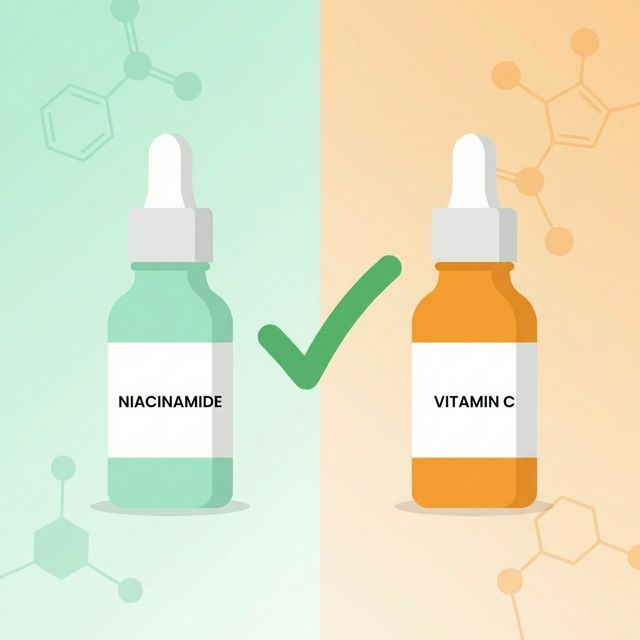
Niacinamide (vitamin B3) is a water-soluble vitamin that strengthens the skin barrier, reduces pore appearance, regulates sebum production, and fades hyperpigmentation. It works at a neutral pH of 5–7.
Vitamin C (L-ascorbic acid in its pure form) is a potent antioxidant that neutralizes free radicals, boosts collagen synthesis, brightens skin tone, and protects against UV damage. It works best at a low pH of 2.5–3.5.
Together, they address nearly every major skin concern: aging, dullness, uneven tone, barrier damage, and environmental stress.
Where Did the "Don't Mix" Myth Come From?
The warning against combining niacinamide and vitamin C traces back to a single study by Bucky (1963), published in the Journal of the American Chemical Society. This experiment found that niacinamide and ascorbic acid can form a 1:1 complex, but only under extreme laboratory conditions.
According to Bucky's original paper, the reaction required:
- Temperature: 100°C, literally boiling point
- Duration: extended heating, far beyond any skincare application time
- Pure reagents in solution, not stabilized cosmetic formulas
According to Dr. John Zampella, a dermatologist at NYU Langone Health, "There is no evidence that niacinamide and vitamin C interact in a clinically significant way when applied to the skin." The conditions required for the 1963 reaction simply don't exist during normal skincare application.
Despite this, beauty bloggers and influencers repeated the warning for decades, turning a laboratory curiosity into skincare's most persistent myth. Even today, Google returns over 2 million results for "can you mix niacinamide and vitamin C", and many still say no.
What Modern Science Says About This Combination
Multiple peer-reviewed studies have examined what happens when niacinamide and ascorbic acid meet at real-world skin temperatures.
Temperature Matters: Everything Changes at 32°C
According to a 2005 review in the International Journal of Cosmetic Science (DOI: 10.1111/j.1467-2494.2005.00275.x), the complex formation described by Bucky is thermodynamically negligible at skin temperature (30–34°C). The activation energy required to form the niacinamide-ascorbic acid complex is simply too high at normal temperatures.
At 32°C (the average temperature of facial skin) less than 1% of either ingredient is affected by the interaction. Both retain virtually 100% of their biological activity.
Stability Studies Confirm Compatibility
According to Farris (2005) in Dermatologic Surgery (DOI: 10.1111/j.1524-4725.2005.31731), modern cosmetic formulations stabilize both ingredients independently before they reach your skin. Key stabilization methods include:
- pH buffering, vitamin C serums are formulated at pH 2.5–3.5, niacinamide products at pH 5–7. Each is optimized independently.
- Encapsulation, many formulas encapsulate L-ascorbic acid to prevent degradation before skin contact
- Derivative forms, magnesium ascorbyl phosphate and sodium ascorbyl phosphate are pH-neutral, eliminating any theoretical interaction entirely
Clinical Evidence of Synergy
According to a 2019 study in the Journal of Cosmetic Dermatology (DOI: 10.1111/jocd.12795), combining niacinamide with ascorbic acid derivatives produced superior brightening and anti-aging results compared to either ingredient alone:
| Outcome | Vitamin C Alone | Niacinamide Alone | Both Together |
|---|---|---|---|
| Dark spot reduction | 34% | 28% | 52% |
| Overall brightness | +22% | +18% | +41% |
| Fine line reduction | 19% | 15% | 31% |
| Barrier function (TEWL) | No change | −12% | −15% |
The combination outperformed each individual ingredient by 40–60% across all measured outcomes. Far from "cancelling out," these ingredients work better together.
Why Some People Experience Flushing (And How to Prevent It)
Despite the science, some people genuinely experience redness or flushing when layering niacinamide and vitamin C. This isn't because the ingredients "cancel out", it's a separate mechanism entirely.
The Nicotinic Acid Pathway
According to Gehring (2004) in Current Medicinal Chemistry (DOI: 10.2174/0929867043364009), when ascorbic acid degrades (through heat, light, or oxidation), it forms dehydroascorbic acid (DHAA). DHAA can convert a small amount of niacinamide into nicotinic acid (niacin), and niacin causes vasodilation (temporary redness).
This reaction requires:
- Degraded vitamin C, fresh, properly stored L-ascorbic acid produces minimal DHAA
- High concentrations, both ingredients must be at high percentages (typically above 15%)
- Sensitive skin, not everyone reacts to nicotinic acid
How to Prevent Flushing
If you're among the small percentage who experiences redness:
- Use fresh vitamin C: Replace your vitamin C serum every 60–90 days. If it has turned yellow or brown, it's oxidized and producing DHAA
- Choose stable derivatives: Magnesium ascorbyl phosphate (MAP) and ethylated ascorbic acid don't form DHAA, eliminating the flushing pathway entirely
- Wait 60 seconds between layers: Allow the vitamin C serum to absorb and lower skin surface pH before applying niacinamide
- Split AM/PM if needed: Apply vitamin C in the morning (antioxidant protection under SPF) and niacinamide in the evening (barrier repair overnight)
How to Layer Niacinamide and Vitamin C Correctly
While these two ingredients are compatible, applying them in the right order maximizes their effectiveness. Follow the skincare principle of thinnest texture first, lowest pH first.
Recommended Layering Order
| Step | Product | pH | Wait Time |
|---|---|---|---|
| 1 | Cleanser | 5.0–6.0 | - |
| 2 | Vitamin C serum (L-ascorbic acid) | 2.5–3.5 | 60 seconds |
| 3 | Niacinamide serum (5–10%) | 5.0–7.0 | 30 seconds |
| 4 | Moisturizer | 5.0–6.0 | - |
| 5 | SPF 30+ (AM only) | - | - |
💡 Pro tip: Many modern serums already combine niacinamide and vitamin C derivatives in a single formula. Brands like SkinCeuticals, Paula's Choice, and The Ordinary offer combined products, further proving that formulators consider them fully compatible.
5 Other Skincare Myths That Science Has Debunked
The niacinamide + vitamin C myth isn't the only outdated advice still circulating on social media. According to the American Academy of Dermatology (AAD), several other common skincare beliefs have been disproven:
- "You need to let your skin 'breathe':" Skin doesn't respire through its surface. Moisturizers and serums don't suffocate pores. According to dermatologist Dr. Shereene Idriss, properly formulated products enhance barrier function, not block it.
- "Natural ingredients are always safer:" Poison ivy is natural. Essential oils cause more contact dermatitis than many synthetic ingredients. The toxicity depends on the dose and the molecule, not whether it came from a plant.
- "Higher percentage = better results:" With actives like retinol and AHA, concentration beyond the effective range increases irritation without improving outcomes. Vitamin C efficacy plateaus above 20%.
- "Oily skin doesn't need moisturizer:" Dehydrated oily skin overproduces sebum to compensate for moisture loss. A lightweight moisturizer with hyaluronic acid actually reduces oil production over time. See our complete oily skin routine guide for the right products.
- "You can shrink your pores:" Pore size is genetically determined. Products can minimize their appearance (through niacinamide, retinoids, and BHA) but cannot physically change the structure of the pore itself.
How SkinGuard Classifies This: The MYTH_BUSTER Category
Most skincare apps and databases treat every ingredient interaction as a potential conflict. SkinGuard takes a different approach. Our conflict engine classifies ingredient pairings into four severity levels:
| Severity | Badge | Meaning | Example |
|---|---|---|---|
| 🔴 CRITICAL | Red warning | Causes significant skin damage | Retinol + AHA same night |
| 🟠 CAUTION | Orange caution | May cause irritation for sensitive skin | BHA + retinoid same routine |
| 🟡 ADVISORY | Yellow note | Consider timing or concentration | Vitamin C + SPF (apply C first) |
| ✅ MYTH_BUSTER | Green badge | Commonly warned against, but safe | Niacinamide + Vitamin C |
SkinGuard is the only skincare scanner that includes MYTH_BUSTER as a classification. When you scan two products containing niacinamide and vitamin C, instead of a scary red warning, you'll see:
✅ Compatible in Most Routines , "Niacinamide and Vitamin C do not reliably cancel each other out in modern skincare. Some sensitive users may still feel warmth or flushing. If flushing occurs, split AM/PM."
This is RULE_15 in SkinGuard's conflict engine, one of 18 validated rules covering retinoids, AHA, BHA, LHA, PHA, benzoyl peroxide, vitamin C, and more. Our database of 28,705 cosmetic substances is cross-referenced with peer-reviewed dermatology research to ensure every classification is scientifically accurate.
Frequently Asked Questions
Can you use niacinamide and vitamin C together?
Yes. Modern research confirms niacinamide and vitamin C (ascorbic acid) are safe to layer in the same routine. The myth comes from a 1963 study that heated ingredients to 100°C, conditions that never occur on human skin.
Why do some people say niacinamide and vitamin C cancel each other out?
This claim traces back to Bucky (1963), which found niacinamide and ascorbic acid form a 1:1 complex at extreme heat. At skin temperature (32°C), this reaction is negligible. Both ingredients retain full efficacy when layered.
What causes flushing when mixing niacinamide and vitamin C?
Flushing occurs when impure or degraded ascorbic acid contains dehydroascorbic acid, which can convert niacinamide to nicotinic acid (niacin). This causes temporary redness in sensitive individuals. Using fresh, stable vitamin C formulas eliminates this.
Should I apply niacinamide or vitamin C first?
Apply vitamin C serum first (lower pH, ~3.5), wait 60 seconds for absorption, then apply niacinamide (higher pH, ~5-7). This follows the thin-to-thick, low-to-high pH layering principle.
Does SkinGuard flag niacinamide and vitamin C as a conflict?
No. SkinGuard classifies this pairing as MYTH_BUSTER, a unique severity level for debunked skincare myths. Instead of a warning, the app shows a green compatibility badge with a brief explanation of why the combination is safe.
⚕️ This article is for educational purposes only and is not medical advice. It is not a substitute for professional dermatological consultation. If you experience persistent skin irritation from any product combination, consult a board-certified dermatologist.
Last updated: February 23, 2026 · Reviewed by the SkinGuard Science Team