Retinol and AHA: The #1 Skincare Conflict (And How to Fix It)
⚡ TL;DR
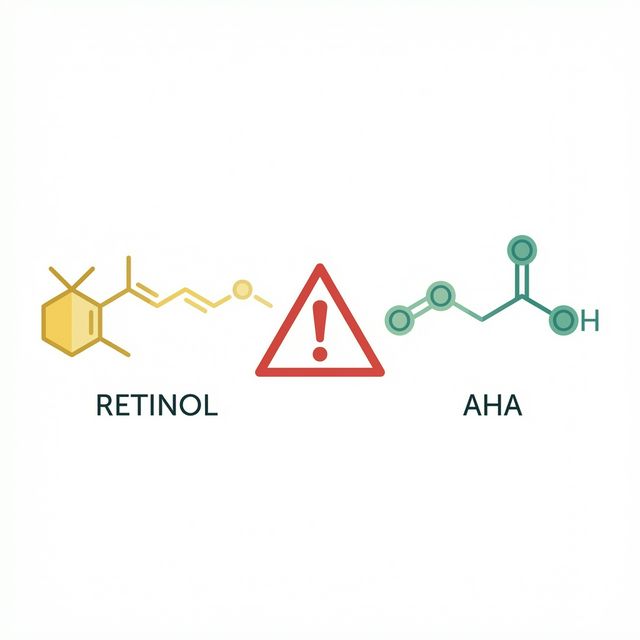
Never layer retinol and AHA (glycolic acid, lactic acid) in the same routine. Both exfoliate your skin through different mechanisms, creating a "double exfoliation" effect that increases transepidermal water loss (TEWL) by 3–4×. SkinGuard flags this as HIGH severity, the #1 most detected conflict in our engine, triggered in 23% of all routine audits. Use alternating nights or an AM/PM split instead.
📖 What Are AHAs (Alpha Hydroxy Acids)?
Alpha hydroxy acids (AHAs) are a group of water-soluble chemical exfoliants derived from natural sources. The most common AHAs in skincare are glycolic acid (from sugarcane, smallest molecule, deepest penetration), lactic acid (from milk, larger molecule, gentler), and mandelic acid (from almonds, largest molecule, mildest). AHAs work by dissolving the intercellular "glue" (desmosomes) between dead skin cells on the surface, promoting exfoliation and revealing fresher skin beneath. At concentrations above 10%, AHAs also stimulate collagen synthesis in the dermis. For a complete comparison of AHA with BHA, LHA, and PHA, see our acid exfoliation guide.
Why Can't You Use Retinol and AHA Together?
Retinol and AHA are both powerhouse ingredients. Individually, each one transforms skin texture, fights acne, and reduces signs of aging. The problem starts when you layer them in the same routine, you're exfoliating from two directions simultaneously.
According to a comprehensive review in the British Journal of Dermatology (Smith, 1996; DOI: 10.1111/j.1365-2133.1996.tb07953.x), alpha hydroxy acids at concentrations above 4% and pH below 4.0 produce measurable exfoliation by disrupting corneocyte cohesion. Meanwhile, retinoids work from the opposite direction, according to Mukherjee et al. (2006) in Clinical Interventions in Aging (DOI: 10.2147/ciia.2006.1.4.327), retinoids accelerate keratinocyte turnover in the basal layer, pushing new cells to the surface faster than normal.
When you combine these two mechanisms:
- AHA dissolves the bonds between dead cells on the surface (top-down exfoliation)
- The vitamin A derivative pushes immature cells to the surface prematurely (bottom-up exfoliation)
- The result: your stratum corneum (only 15–20 cell layers thick) gets attacked from both sides, leaving raw, unprotected skin exposed
According to research in Dermatologic Surgery (Brody, 1997; DOI: 10.1111/j.1524-4725.1997.tb00078.x), this dual exfoliation compromises the epidermal barrier faster than either ingredient alone, increasing transepidermal water loss (TEWL) by 3–4× above baseline. The compromised barrier also lets irritants and UV radiation penetrate deeper.
SkinGuard's Conflict Data: Retinol × Every Exfoliant
This is the #1 most triggered conflict rule in SkinGuard's Conflict Engine. Our analysis of 28,705 verified cosmetic substances across real user routines shows this combination detected in 23% of all routine audits. Here's how every retinoid × exfoliant combination ranks:
| Combination | SkinGuard Rule | Severity | Risk Type |
|---|---|---|---|
| Retinol + Glycolic Acid (AHA) | RULE_01 | 🔴 HIGH | High Irritation / Overuse Risk |
| Retinol + Lactic Acid (AHA) | RULE_01 | 🔴 HIGH | High Irritation / Overuse Risk |
| Retinol + Mandelic Acid (AHA) | RULE_01 | 🔴 HIGH | High Irritation / Overuse Risk |
| Retinol + Salicylic Acid (BHA) | RULE_02 | 🔴 HIGH | High Dryness and Peeling Risk |
| Retinol + LHA (Capryloyl Salicylic Acid) | RULE_02 | 🔴 HIGH | High Dryness and Peeling Risk |
| Retinol + PHA (Gluconolactone) | RULE_14 | 🟡 MEDIUM | Usually Gentle, Still Can Sting |
| Physical Scrub + Retinol/AHA/BHA | RULE_CRITICAL_02 | 🔴 HIGH | High Risk of Barrier Damage |
Source: SkinGuard Conflict Engine v2.0, 18 validated rules covering RETINOIDS, AHA, BHA, LHA, PHA, Benzoyl Peroxide, Vitamin C, and more. Data from 28,705 cosmetic substance analyses. Retinol also conflicts with benzoyl peroxide, see our full BP conflicts guide.
SkinGuard flags RETINOIDS × AHA as HIGH, "High Irritation / Overuse Risk"
The app covers RETINOIDS × AHA (RULE_01), RETINOIDS × BHA/LHA (RULE_02), and RETINOIDS × PHA (RULE_14). When detected, SkinGuard shows an orange HIGH-severity alert with specific scheduling guidance, alternate nights or AM/PM split, so you never have to guess.
The Science: How Double Exfoliation Damages Your Skin
Your stratum corneum follows a "bricks and mortar" model, corneocytes (dead skin cells) are the bricks, and intercellular lipids (ceramides, cholesterol, free fatty acids) are the mortar. According to Elias (2005) in the Journal of Clinical Investigation, this barrier is only 10–20 μm thick but prevents 98% of water loss from the body.
Here's what each ingredient does to this barrier:
How AHA Works (Top-Down)
AHAs (particularly glycolic acid, the smallest AHA molecule) penetrate the stratum corneum and dissolve desmosomes, the protein bridges connecting adjacent corneocytes. According to a study in the Journal of the American Academy of Dermatology (Ditre et al., 1996; DOI: 10.1016/s0190-9622(96)90602-8), glycolic acid at 8% concentration increases epidermal thickness by 25% over 6 months by stimulating cell renewal, but it simultaneously thins the dead cell layer on top, reducing protection.
How This Vitamin A Derivative Works (Bottom-Up)
This ingredient converts to retinoic acid in the skin, binding to RAR/RXR nuclear receptors in keratinocytes. This upregulates genes controlling cell proliferation and differentiation. According to Kligman (1986) in the Journal of the American Academy of Dermatology (DOI: 10.1016/s0190-9622(86)70214-0), retinoids reduce stratum corneum thickness by 20–40% within 4–8 weeks. Cells reach the surface before fully maturing, creating a thinner, more fragile barrier.
The Compounding Effect
When these two mechanisms operate simultaneously:
- Surface bonds dissolve faster (AHA removes the "mortar")
- Fewer replacement cells arrive mature enough to serve as a barrier (the retinoid pushes immature cells)
- TEWL skyrockets 3–4× above baseline, your skin literally cannot hold water
- UV sensitivity increases dramatically, both ingredients make skin more photosensitive, compounding each other's effect
The visible result: redness, peeling, stinging, dryness, and in severe cases, "retinoid dermatitis" , an inflammatory reaction that can take 2–4 weeks to resolve.
5 Signs You're Over-Exfoliating (Retinol + AHA Damage)
If you've been layering these two actives in the same routine, watch for these warning signs:
- Persistent redness that doesn't fade: Normal "retinization flush" lasts 30–60 minutes. If redness persists for hours or appears daily, your barrier is compromised
- Skin feels tight after cleansing: The stratum corneum can no longer retain moisture. Even gentle cleansers strip residual oils from the thinned barrier
- Stinging when applying moisturizer: Products that never irritated before now burn on contact, a hallmark of barrier disruption
- Visible flaking or peeling: Sheets of dead skin lifting off (desquamation) indicate the stratum corneum is shedding faster than it can rebuild
- Breakouts in areas that were clear: A compromised barrier allows bacteria and irritants to penetrate, triggering new acne in previously clear zones
If you notice three or more of these signs, stop both actives immediately. Switch to a barrier-repair routine (ceramides, hyaluronic acid, petrolatum) for 7–14 days before reintroducing one ingredient at a time.
3 Safe Ways to Use Retinol and AHA (Without Conflict)
The goal is never "stop using one." Both retinol and AHA are clinically proven to improve skin. According to Draelos (2006) in Cosmeceuticals (DOI: 10.1016/B978-1-4160-2452-4.50010-5), the key is temporal separation, giving each ingredient enough time to work without overwhelming the barrier.
Strategy 1: Alternate Nights (Recommended)
The safest approach for most skin types. Apply retinol on Monday, Wednesday, and Friday evenings. Apply AHA on Tuesday and Thursday evenings. Reserve weekends for barrier-repair hydration only.
| Day | Mon | Tue | Wed | Thu | Fri | Sat | Sun |
|---|---|---|---|---|---|---|---|
| PM | Retinol | AHA | Retinol | AHA | Retinol | Rest | Rest |
Why it works: 24+ hours between conflicting actives gives the stratum corneum time to stabilize. According to Kang et al. (2005) in Journal of Investigative Dermatology, retinoid-induced gene expression changes diminish significantly within 24 hours of cessation.
Strategy 2: AM/PM Split
Use AHA in your morning routine (followed by SPF 30+) and your retinoid in the evening routine. This provides 8–12 hours of separation. Less ideal than alternate nights because some barrier stress accumulates within a single day, but effective for experienced users with resilient skin.
⚠️ Mandatory: AHA increases UV sensitivity by up to 50% (FDA, 2005). If you use AHA in the morning, you must apply SPF 30+ sunscreen. Without it, you're accelerating photoaging, the opposite of what you want.
Strategy 3: The Sandwich Method (Buffer)
For sensitive skin that reacts to even alternating nights: apply moisturizer first, then your active (retinol OR AHA, never both), then another layer of moisturizer. The moisturizer "sandwich" creates a buffer that slows active ingredient penetration and reduces irritation.
This strategy works best when combined with Strategy 1 (alternate nights + sandwich each application).
The Cleanser Exception: When AHA + Retinol Risk Drops
There's one notable exception to the "never mix" rule: AHA in a wash-off cleanser.
According to the International Journal of Cosmetic Science (Kornhauser et al., 2010), AHA exposure time directly correlates with exfoliation depth. A cleanser containing 2–5% glycolic acid, used for under 60 seconds, delivers significantly less exfoliation than a leave-on serum at the same concentration.
This means: an AHA cleanser in the morning + your retinoid in the evening is a lower-risk combination than two leave-on products. However, SkinGuard still flags this pairing because contact time varies with user behavior, someone who leaves a cleanser on for 3 minutes while multitasking will experience meaningful exfoliation.
Retinol + BHA (Salicylic Acid): A Different Risk Profile
SkinGuard classifies retinol + BHA under a separate rule (RULE_02) with a different risk label: "High Dryness and Peeling Risk." This distinction matters.
Unlike AHAs, BHA (salicylic acid) is oil-soluble. It penetrates into pores rather than working only on the surface. When combined with bottom-up retinoid exfoliation, BHA strips protective sebum from inside the pore while the vitamin A derivative thins the skin around it. The result is deep dryness that feels different from AHA overexfoliation:
- AHA + Retinoid: Surface redness, peeling, stinging (barrier disruption)
- BHA + Retinoid: Deep dryness, tight feeling, flaking from within pores (lipid stripping)
Both are HIGH severity in SkinGuard, but the fix is the same: alternate nights with at least 24 hours of separation between applications.
Retinol + PHA: The Safest Exfoliant Pairing
PHAs (polyhydroxy acids) like gluconolactone and lactobionic acid have the largest molecule size among hydroxy acids. Their bigger structure means slower, more superficial penetration. SkinGuard classifies retinol + PHA as MEDIUM severity (RULE_14). "Usually Gentle, Still Can Sting."
For sensitive skin types seeking both retinoid benefits and chemical exfoliation, PHA is the most compatible option. However, "gentler" doesn't mean "risk-free", start with alternate nights before combining in the same routine, and monitor for any signs of barrier stress described in the 5 signs section above.
How SkinGuard Detects and Prevents This Conflict
SkinGuard's Conflict Engine runs 18 validated rules against your routine in real time. Here's what happens when retinol + AHA is detected:
- Scan: You photograph your product labels or search by name. SkinGuard's NLP parser identifies retinol, retinaldehyde, retinyl palmitate, tretinoin, and 12+ other retinoid variants across our database of 28,705 verified substances
- Match: The engine cross-references all products in your routine. If any RETINOID group ingredient appears alongside any AHA/BHA/LHA ingredient, RULE_01 or RULE_02 triggers
- Alert: An orange HIGH-severity alert appears with the specific conflict pair, risk description, and recommended scheduling strategy
- Guide: The app suggests alternate-night scheduling, shows which products to separate, and monitors your routine for re-introduced conflicts
No guesswork. No Googling ingredient lists. No accidentally layering glycolic acid under your vitamin A serum because you forgot what's in your toner.
Frequently Asked Questions
Can you use retinol and glycolic acid together?
No. Retinol and glycolic acid (an AHA) both exfoliate skin through different mechanisms. Using them together in the same routine causes double exfoliation, stripping the stratum corneum and increasing TEWL by 3–4×. Alternate nights or use an AM/PM split instead.
What happens if you mix retinol and AHA?
Mixing retinol and AHA disrupts the skin barrier from two directions, retinol accelerates cell turnover from below while AHA dissolves the bonds between dead cells above. This double exfoliation leads to redness, peeling, stinging, dryness, and increased sensitivity to UV.
Can you use retinol and salicylic acid (BHA) together?
SkinGuard classifies retinol + BHA as HIGH severity with "High Dryness and Peeling Risk." BHA's oil-soluble exfoliation penetrates pores deeply, combined with retinol's cell turnover this strips protective lipids. Use on alternating nights.
How do you safely schedule retinol and AHA?
Three safe methods: (1) Alternate nights, retinol Monday/Wednesday/Friday, AHA Tuesday/Thursday. (2) AM/PM split. AHA in AM with sunscreen, retinol at PM. (3) Sandwich method, moisturizer, then active, then moisturizer to buffer penetration.
Is lactic acid safer to use with retinol than glycolic acid?
Lactic acid is a milder AHA with larger molecule size, but SkinGuard still classifies retinol + any AHA as HIGH severity. Lactic acid at low concentrations (under 5%) causes less irritation, but the double-exfoliation risk remains. Schedule them on separate evenings.
📚 References
- Kligman, A. M. (1986). The growing importance of topical retinoids in clinical dermatology. Journal of the American Academy of Dermatology, 15(4), 860–876. DOI: 10.1016/s0190-9622(86)70214-0
- Mukherjee, S., et al. (2006). Retinoids in the treatment of skin aging. Clinical Interventions in Aging, 1(4), 327–348. DOI: 10.2147/ciia.2006.1.4.327
- Smith, W. P. (1996). Epidermal and dermal effects of topical lactic acid. British Journal of Dermatology, 135(5), 713–718. DOI: 10.1111/j.1365-2133.1996.tb07953.x
- Ditre, C. M., et al. (1996). Effects of α-hydroxy acids on photoaged skin. Journal of the American Academy of Dermatology, 34(2), 187–195. DOI: 10.1016/s0190-9622(96)90602-8
- Brody, H. J. (1997). Chemical peeling and resurfacing. Dermatologic Surgery, 23(6), 435–441. DOI: 10.1111/j.1524-4725.1997.tb00078.x
- Draelos, Z. D. (2006). Cosmeceuticals (2nd ed.). Elsevier. DOI: 10.1016/B978-1-4160-2452-4.50010-5
⚕️ Medical Disclaimer: This article is for educational purposes only and does not replace medical advice. Consult a board-certified dermatologist before changing your skincare routine, especially if you use prescription retinoids. SkinGuard is a cosmetic analysis tool, not a medical device.