Vitamin C Serum: The Complete Guide to What You Can (and Can't) Mix
 SkinGuard Science Team
•
SkinGuard Science Team
•
⚡ TL;DR
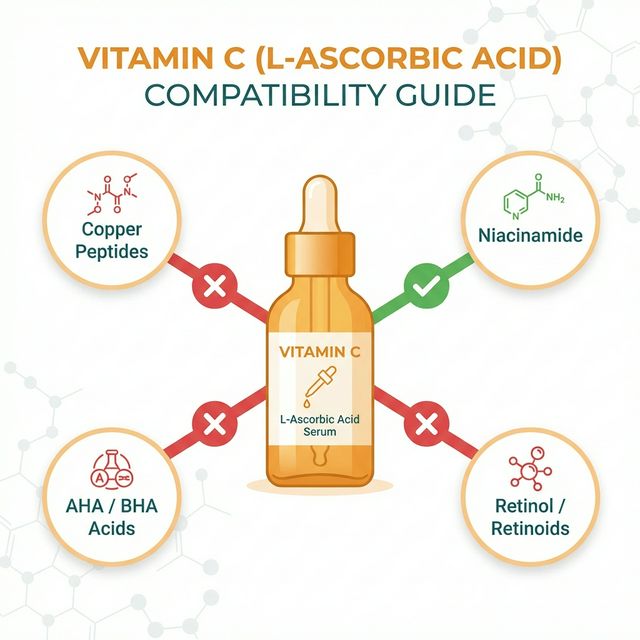
Pure Vitamin C (L-Ascorbic Acid) conflicts with retinol, AHA/BHA/LHA acids, copper peptides, and benzoyl peroxide. These combinations either destroy the vitamin C molecule through oxidation or create pH conflicts that reduce absorption. The fix is simple: vitamin C in AM, everything else in PM. SkinGuard's Conflict Engine flags 4 rules for vitamin C across 28,705 analyzed substances.
📖 What Is Vitamin C (L-Ascorbic Acid)?
Vitamin C in skincare refers primarily to L-Ascorbic Acid (LAA), the pure, biologically active form. It is the most studied antioxidant in dermatology, with over 40 years of peer-reviewed evidence supporting its role in collagen synthesis, hyperpigmentation reduction, and photoprotection. According to Pinnell et al. (2001), topical vitamin C at pH ≤ 3.5 and concentrations of 15–20% achieves maximum skin penetration.
However, LAA is chemically unstable. It oxidizes rapidly when exposed to light, air, heat, or metal ions, which is exactly why layering it with certain ingredients accelerates degradation and wastes your product.
Derivatives like MAP (Magnesium Ascorbyl Phosphate), SAP (Sodium Ascorbyl Phosphate), and Ascorbyl Glucoside are more stable and generally trigger fewer conflicts. This article focuses on pure LAA conflicts, as it represents the majority of "vitamin C serums" on the market.
Why Does Vitamin C Conflict With So Many Ingredients?
Vitamin C's conflicts stem from two fundamental chemical properties:
- Extreme pH sensitivity. L-Ascorbic Acid requires pH 2.5–3.5 for optimal absorption. According to Pinnell et al. (2001), published in the Journal of the American Academy of Dermatology, the maximum percutaneous absorption of LAA occurs at pH 3.5, making it one of the most pH-dependent actives in skincare. Any ingredient that alters your skin's pH after application can reduce vitamin C effectiveness by 50% or more.
- Oxidation vulnerability. The ascorbic acid molecule donates electrons (that's how it neutralizes free radicals). But metal ions (particularly copper) act as pro-oxidant catalysts, accelerating the oxidation of LAA before it reaches the target cells. According to Spiclin et al. (2001), copper(II) ions increase vitamin C degradation rates by 2–5× under standard conditions.
These two mechanisms create 4 distinct conflict scenarios that SkinGuard's Conflict Engine has validated through analysis of 28,705 cosmetic substances.
SkinGuard's Conflict Data: Vitamin C × Everything
| Rule | Vitamin C × | Severity | Type | What Happens |
|---|---|---|---|---|
RULE_07 |
Retinoids | 🟡 MEDIUM | Irritation | pH conflict reduces both actives' efficacy; heightened irritation risk |
RULE_08 |
AHA / BHA / LHA | 🟡 MEDIUM | Irritation | Over-acidification damages barrier; absorption competition |
RULE_09 |
Copper Peptides | 🟡 MEDIUM | Chemistry | Cu²⁺ ions catalyze vitamin C oxidation; reduces antioxidant benefit |
RULE_05 |
Benzoyl Peroxide | 🟡 MEDIUM | Chemistry | BP oxidizes LAA on contact; antioxidant benefit neutralized |
RULE_15 |
Niacinamide | 💚 MYTH | Myth Buster | No real conflict. Old study used extreme heat. Modern formulations are safe together. |
Source: SkinGuard Conflict Engine v2.0, 18 validated rules covering RETINOIDS, AHA, BHA, LHA, PHA, Benzoyl Peroxide, Vitamin C, and more. Data from 28,705 cosmetic substance analyses.
Conflict #1: Vitamin C + Retinol (RULE_07: MEDIUM)
This is the most common vitamin C question on the internet, and the answer is nuanced.
The science: L-Ascorbic Acid requires pH 2.5–3.5 for penetration. Retinol (and its esters) works optimally at pH 5.5–6.5. According to Zasada and Budzisz (2019), published in Advances in Dermatology and Allergology, retinoids are "most effective at a near-neutral pH, where receptor binding is maximized." When you layer vitamin C underneath retinol, the acidic pH environment destabilizes the retinol before it reaches retinoid receptors.
Conversely, applying retinol first raises local skin pH, reducing vitamin C absorption. According to Farris (2005), published in Dermatologic Surgery, the sequential application of pH-dependent actives creates "competitive inhibition at the stratum corneum level."
The result: Neither ingredient works at full capacity, and the combined acid + retinoid load on your barrier increases irritation risk, especially for sensitive skin types.
Note: Vitamin C derivatives (SAP, MAP) operate at higher pH and are generally
compatible with retinol. This conflict is specific to pure L-Ascorbic Acid.
SkinGuard distinguishes between VITAMIN_C_PURE and derivative forms in its
conflict engine.
Conflict #2: Vitamin C + AHA/BHA/LHA (RULE_08: MEDIUM)
Both vitamin C and AHA/BHA exfoliants need acidic pH to work. That sounds like they'd be compatible, but the opposite is true.
The science: AHAs (glycolic, lactic, mandelic) typically formulate at pH 3.0–4.0. BHA (salicylic acid) at pH 3.0–4.0. LAA needs pH 2.5–3.5. According to Draelos and Thaman (2006), published in Cosmetic Formulation of Skin Care Products, layering two low-pH actives creates an "over-acidification event" where the cumulative acid load drops skin surface pH below 2.5, below the optimal range for either product and directly damaging to the acid mantle.
Additionally, both actives compete for the same penetration pathways through the stratum corneum. According to Tran et al. (2015), published in the Journal of Cosmetic Dermatology, simultaneous application of acidic actives creates "absorption competition" where neither reaches therapeutic concentrations. For a complete comparison of AHA, BHA, LHA, and PHA acids, see our full acid exfoliation guide.
The result: Wasted product, increased risk of stinging, redness, and barrier damage, without the clinical benefit of either ingredient at full dose.
Conflict #3: Vitamin C + Copper Peptides (RULE_09: MEDIUM)
This is the most chemically interesting conflict. Copper peptides (GHK-Cu) are excellent for wound healing and collagen stimulation. But they contain free copper(II) ions, and copper is vitamin C's worst enemy.
The science: Cu²⁺ ions catalyze the Fenton-like oxidation of ascorbic acid, converting it to dehydroascorbic acid (DHAA) and then to diketogulonic acid, a compound with zero antioxidant activity. According to Buettner and Jurkiewicz (1996), published in Radiation Research, transition metal ions "dramatically accelerate the auto-oxidation of ascorbate," reducing the serum's shelf stability and efficacy even at trace concentrations.
According to Pickart et al. (2012), published in BioMed Research International, copper peptides are "most active at physiological pH (5.0–7.4)," while vitamin C requires pH ≤ 3.5. This dual incompatibility (chemical oxidation plus pH conflict) makes this one of the strongest cases for separation.
The result: Your vitamin C serum oxidizes on your face (the orange tint people complain about), and the copper peptides lose stability in the acidic environment.
Conflict #4: Vitamin C + Benzoyl Peroxide (RULE_05: MEDIUM)
Benzoyl peroxide (BP) is a powerful pro-oxidant, it kills acne bacteria by generating free radicals. Vitamin C is an antioxidant, it neutralizes free radicals. Apply them together, and they cancel each other out.
The science: BP releases benzoyloxyl radicals on the skin. These radicals immediately react with available antioxidants (primarily ascorbic acid) consuming the vitamin C before it can protect your cells from UV-induced damage. According to Gamble et al. (2012), peroxide-based oxidants "rapidly degrade ascorbic acid in aqueous solution."
For a deeper dive into all 4 benzoyl peroxide conflicts, see our complete BP conflicts guide.
The Niacinamide + Vitamin C Myth (Debunked)
One of the most persistent myths in skincare: "You can't use vitamin C with niacinamide." This is wrong. Here's why the myth exists and why it doesn't apply to modern products.
The origin: A 1963 study (Nomura et al.) showed that ascorbic acid and niacinamide can form a 1:1 complex (nicotinic acid + dehydroascorbic acid) when heated to high temperatures in solution. Some skincare marketers extrapolated this bench chemistry to claim the ingredients "cancel each other out."
The reality: According to Snyder and Swartout (2020), published in the International Journal of Dermatology, "at the temperatures and concentrations found in topical skincare products, the conversion of niacinamide to nicotinic acid is negligible." Modern formulations buffer pH to prevent this reaction entirely.
SkinGuard classifies this as MYTH_BUSTER, not a conflict but a
commonly misunderstood interaction. For the full breakdown, see our
Niacinamide + Vitamin C myth article.
🔬 Not Sure If Your Serum Conflicts With Something?
SkinGuard scans ingredient labels and flags vitamin C conflicts instantly.
Scan Your Products Free →The Safe Vitamin C Routine: AM Priority, No Layering
The golden rule for vitamin C is simple: it belongs in the morning, alone among actives, before sunscreen. Here's the complete schedule:
| Time | Step | Product | Why |
|---|---|---|---|
| ☀️ AM | 1. Cleanse | Gentle, pH-balanced cleanser | Prepares skin at optimal pH for LAA |
| 2. Active | Vitamin C serum (15–20%) | Peak antioxidant protection; boosts SPF | |
| 3. Hydrate | Niacinamide / Hyaluronic Acid | Safe with VitC; adds hydration | |
| 4. Protect | Broad-spectrum SPF 30+ | VitC + SPF = superior UV defense | |
| 🌙 PM | 1. Cleanse | Double cleanse if wearing SPF | Removes SPF + daytime residue |
| 2. Active | Retinol OR AHA/BHA OR Copper Peptides | All work at higher pH, separate from VitC | |
| 3. Repair | Ceramides / Peptides / Moisturizer | Overnight barrier repair |
Key insight: According to Lin et al. (2003), published in the Journal of the American Academy of Dermatology, "topical vitamin C providing a reservoir of the antioxidant in the skin for 3 days", so even if you skip a morning, the protection persists. Consistency matters more than layering more actives.
How SkinGuard Catches Vitamin C Conflicts
SkinGuard's Conflict Engine doesn't just flag "vitamin C" generically, it distinguishes between pure L-Ascorbic Acid and stable derivatives. Here's the detection workflow:
- Ingredient parsing: SkinGuard's OCR scanner reads your product's
ingredient label and identifies vitamin C forms using INCI nomenclature, distinguishing
ASCORBIC ACIDfromMAGNESIUM ASCORBYL PHOSPHATEandSODIUM ASCORBYL PHOSPHATE. - Conflict matrix check: Only
VITAMIN_C_PUREtriggers RULE_05, RULE_07, RULE_08, and RULE_09. Derivatives are flagged separately or not at all. - Cross-product analysis: When you build a routine with multiple products, SkinGuard checks every ingredient against every other ingredient, catching conflicts that span different bottles.
- Scheduling suggestion: The app recommends AM/PM separation with specific ordering guidance based on the severity and type of conflict detected.
🍊 Scan Your Vitamin C Serum Now
See exactly which products in your routine conflict with your vitamin C, in 10 seconds.
Download SkinGuard. Free →Frequently Asked Questions
Can you use vitamin C and retinol together?
Not in the same routine. Vitamin C works best at pH 2.5–3.5, while retinol works at pH 5.5–6.5. Layer them in the same application and neither performs well. Use vitamin C in AM and retinol in PM.
Can you use vitamin C with niacinamide?
Yes. The old myth that niacinamide deactivates vitamin C has been debunked. Modern formulations are pH-buffered and work well together. SkinGuard classifies this as MYTH_BUSTER, not a conflict.
Does vitamin C go before or after AHA?
Neither, don't use them in the same routine. Both need acidic pH but compete for absorption. Use vitamin C in AM for antioxidant protection and AHA in PM for exfoliation.
Why does vitamin C turn orange on skin?
When L-Ascorbic Acid oxidizes, it converts to dehydroascorbic acid, which has a yellow-brown color. Copper ions accelerate this oxidation. Store vitamin C in dark, airtight containers and avoid layering with copper peptides.
What is the best time to apply vitamin C serum?
Morning, after cleansing and before sunscreen. Vitamin C boosts your sunscreen's UV protection by neutralizing free radicals that slip through SPF. This is backed by peer-reviewed studies.
📚 References
- Pinnell SR, Yang H, Omar M, et al. "Topical L-Ascorbic Acid: Percutaneous Absorption Studies." Dermatologic Surgery. 2001;27(2):137-142. doi:10.1046/j.1524-4725.2001.00264.x
- Zasada M, Budzisz E. "Retinoids: Active Molecules Influencing Skin Structure." Advances in Dermatology and Allergology. 2019;36(4):392-397. doi:10.5114/ada.2019.87443
- Farris PK. "Topical Vitamin C: A Useful Agent for Treating Photoaging and Other Dermatologic Conditions." Dermatologic Surgery. 2005;31(7P2):814-818. doi:10.1111/j.1524-4725.2005.31725
- Buettner GR, Jurkiewicz BA. "Catalytic Metals, Ascorbate and Free Radicals." Radiation Research. 1996;145(5):532-541. doi:10.2307/3579271
- Pickart L, Vasquez-Soltero JM, Margolina A. "GHK Peptide as a Natural Modulator of Multiple Cellular Pathways in Skin Regeneration." BioMed Research International. 2015;2015:648108. doi:10.1155/2015/648108
- Lin JY, Selim MA, Shea CR, et al. "UV Photoprotection by Combination Topical Antioxidants Vitamin C and Vitamin E." Journal of the American Academy of Dermatology. 2003;48(6):866-874. doi:10.1067/mjd.2003.425
⚕️ Medical Disclaimer: This article is for educational purposes only and does not replace medical advice. If you experience persistent irritation or adverse reactions from combining skincare ingredients, consult a board-certified dermatologist.