Skincare Allergens: The Complete Guide to Identifying and Avoiding Them
⚡ TL;DR
The EU mandates disclosure of 26 specific fragrance allergens on cosmetic labels. According to the European Society of Contact Dermatitis, up to 10% of the population reacts to at least one of these allergens. "Hypoallergenic" is an unregulated marketing term. This guide lists every regulated allergen, explains how patch testing works, and shows you how to scan products for allergens automatically.
📖 What Is a Cosmetic Allergen?
A cosmetic allergen is a substance that triggers an immune-mediated allergic contact dermatitis (ACD) reaction. According to the American Contact Dermatitis Society, ACD is a Type IV (delayed) hypersensitivity reaction — meaning symptoms appear 24-72 hours after exposure, not immediately. This delayed onset makes identifying the culprit ingredient extremely difficult without professional patch testing.
The EU 26 Allergens: Complete List
According to EU Cosmetics Regulation (EC 1223/2009) Annex III, manufacturers must declare these 26 fragrance allergens on the label when present above 10 ppm (0.001%) in leave-on products or 100 ppm (0.01%) in rinse-off products:
| INCI Name | Common Name | Found In | Prevalence |
|---|---|---|---|
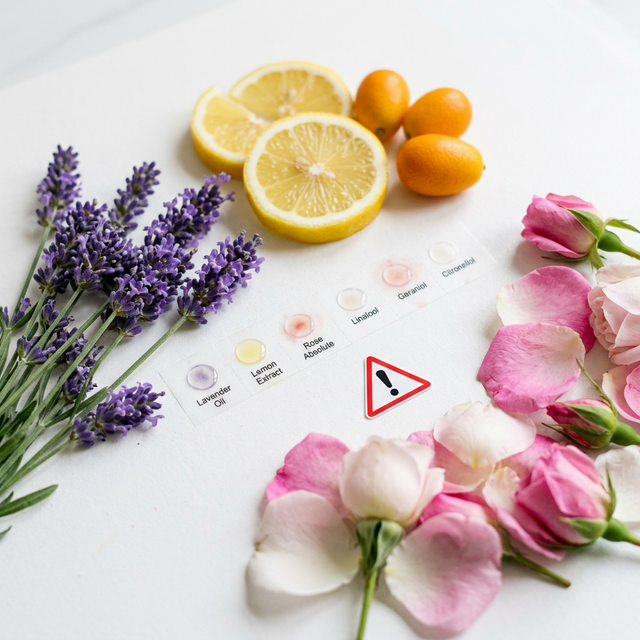
| Linalool | Lavender/citrus compound | Moisturizers, cleansers, perfumes | 🔴 Very common |
| Limonene | Citrus compound | Cleansers, toners, lip products | 🔴 Very common |
| Citronellol | Rose/geranium compound | Moisturizers, body lotions | 🔴 Very common |
| Geraniol | Rose compound | Body lotions, hand creams | 🟡 Common |
| Coumarin | Vanilla-like compound | Perfumes, body products | 🟡 Common |
| Citral | Lemon compound | Cleansers, toners | 🟡 Common |
| Benzyl Alcohol | Preservative/fragrance | Many product types | 🟡 Common |
| Eugenol | Clove compound | Lip products, toothpaste | 🟡 Common |
| Cinnamal | Cinnamon compound | Fragranced products | ⚪ Less common |
| Isoeugenol | Vanilla-like compound | Fragranced products | ⚪ Less common |
| HICC (Lyral) | Synthetic musk | Being phased out (banned since 2021) | 🔴 Banned |
| Farnesol | Floral compound | Deodorants, moisturizers | ⚪ Less common |
Table shows the 12 most clinically relevant of the 26; the remaining 14 (including benzyl benzoate, benzyl cinnamate, amyl cinnamal, etc.) are less common triggers.
Beyond the EU 26: Other Common Sensitizers
According to dermatologist Dr. Sandy Skotnicki, author of Beyond Soap, the EU 26 list covers only fragrance allergens. Other common cosmetic sensitizers include:
- Methylisothiazolinone (MI/MCI): According to the American Contact Dermatitis Society, MI was named "Allergen of the Year" in 2013. It's a preservative found in moisturizers, shampoos, and baby wipes. Sensitivity rates reached 6% in some European populations before regulations tightened
- Formaldehyde releasers: DMDM hydantoin, imidazolidinyl urea, quaternium-15, and bronopol slowly release formaldehyde — a known sensitizer. According to the CIR, these are safe below certain thresholds, but sensitized individuals may react at any concentration (DOI: 10.1111/cod.13767)
- Essential oils: According to a 2020 study in Contact Dermatitis (DOI: 10.1111/cod.13489), tea tree oil, lavender oil, and ylang-ylang oil are increasingly common allergens — especially in "natural" skincare products
- PPD (paraphenylenediamine): Found in hair dyes. According to the British Association of Dermatologists, PPD allergy affects 1-6% of people who use hair dyes
How Patch Testing Works
According to the American Contact Dermatitis Society, patch testing is the gold standard for diagnosing allergic contact dermatitis. Here's the process:
- Day 1 — Application: A dermatologist applies small chambers containing suspected allergens (typically the T.R.U.E. TEST or expanded series) to your upper back
- Day 3 — First reading (48 hours): Chambers are removed and initial reactions are recorded
- Day 4-5 — Final reading (72-96 hours): The definitive reading. True allergic reactions typically peak at 72-96 hours. Irritant reactions (false positives) fade by this point
- Results interpretation: Reactions are graded: +1 (weak), +2 (strong), +3 (extreme). Your dermatologist maps positive results to specific product ingredients
When to get patch tested: According to Dr. Skotnicki, consider testing if you have recurring facial eczema or dermatitis that doesn't respond to treatment, or if you've had reactions to multiple products. For more on fragrance-specific concerns, see our Fragrance in Skincare: Is It Bad? guide.
"Hypoallergenic": What the Label Really Means
According to the FDA, the term "hypoallergenic" has no legal definition or regulatory standard. In 1975, the FDA attempted to define the term and require testing — cosmetic companies sued and won. The result:
- Any product can be labeled "hypoallergenic" without any testing
- There is no required threshold for allergen content
- According to a 2017 study in JAMA Dermatology (DOI: 10.1001/jamadermatol.2017.0198), 83% of "hypoallergenic" moisturizers contained at least one known allergen
Bottom line: Ignore the label. Check ingredients. For sensitive skin routine recommendations, see our Skincare Routine for Sensitive Skin guide.
How SkinGuard Detects Allergens
According to SkinGuard's ingredient database, the app provides multi-layer allergen detection:
- All 26 EU-regulated fragrance allergens — flagged automatically with concentration relevance (top-10 position vs. end-of-list position)
- Extended sensitizer database: MI, formaldehyde releasers, PPD, and 50+ additional known contact allergens beyond the EU 26
- Essential oil allergen mapping: When the INCI list shows "Lavandula Angustifolia Oil," SkinGuard knows this contains linalool and linalyl acetate — and flags accordingly
- Cross-product allergen load: Total allergen exposure across your routine, not just per-product. For product safety checking, see our Is Your Skincare Safe? guide
Frequently Asked Questions
What are the most common allergens in skincare?
The most common cosmetic allergens are fragrance compounds: linalool, limonene, citronellol, geraniol, and coumarin. MI (methylisothiazolinone) is the most common non-fragrance cosmetic allergen.
What does "hypoallergenic" mean on skincare products?
Legally, almost nothing. The term is not regulated by the FDA or EU. A product labeled "hypoallergenic" can still contain known allergens. Always check the INCI list rather than relying on marketing claims.
How do I know if I'm allergic to a skincare ingredient?
The gold standard is a patch test by a dermatologist. Self-diagnosis from product reactions is unreliable because irritation and allergy have different mechanisms.
Can you develop new skincare allergies over time?
Yes. Contact allergy is an acquired immune response. You can use a product for months or years before becoming sensitized through repeated low-level exposure.
Are natural skincare products less allergenic?
No. Natural and botanical ingredients are among the most common causes of allergic contact dermatitis. Essential oils contain multiple allergens. Synthetic ingredients are often better characterized and more predictable.
📚 References
- European Commission. (2009). Regulation (EC) No 1223/2009, Annex III — List of substances which cosmetic products must not contain. EU CosIng Database
- Warshaw, E. M., et al. (2017). Allergens in "hypoallergenic" cosmetics. JAMA Dermatology, 153(10). DOI: 10.1001/jamadermatol.2017.0198
- Uter, W., et al. (2020). Essential oils and contact allergy. Contact Dermatitis, 83(4). DOI: 10.1111/cod.13489
- Schwensen, J. F., et al. (2021). Formaldehyde releaser contact allergy. Contact Dermatitis, 85(6). DOI: 10.1111/cod.13767
⚕️ Medical Disclaimer: This article is for educational purposes only. If you suspect contact allergy, consult a dermatologist for professional patch testing. Do not self-diagnose or self-treat allergic contact dermatitis.