Glycolic Acid Exfoliation: What Dermatology Research Shows About Collagen, Acne & Safe Use
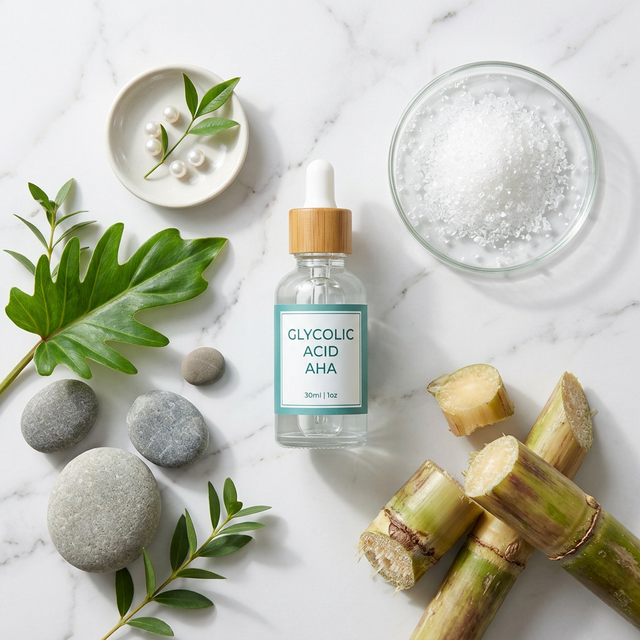
Glycolic acid is the smallest and most potent alpha-hydroxy acid (AHA). Derived from sugarcane, its tiny molecular weight lets it penetrate deeper than any other AHA — which is both its greatest advantage and its greatest risk. Here is what peer-reviewed dermatology research actually shows about using it safely.
⚡ TL;DR
Glycolic acid is the gold standard AHA for chemical exfoliation. According to a 1996 vehicle-controlled study in Dermatologic Surgery, weekly 50% glycolic acid peels increased dermal collagen thickness within four weeks. At lower over-the-counter concentrations (5-10%), it smooths texture, reduces acne, and fades hyperpigmentation — but its low pH makes it a high-conflict ingredient that must be layered carefully to avoid barrier damage.
📖 What Is Glycolic Acid?
Glycolic acid (INCI: Glycolic Acid) is an alpha-hydroxy acid derived from sugarcane with a molecular weight of just 76 Da — the smallest of all AHAs. According to the U.S. FDA, AHAs work by loosening the bonds between dead skin cells in the stratum corneum, promoting natural exfoliation without physical abrasion.
Its small size allows it to penetrate deeper into the epidermis and even the dermis, where it stimulates fibroblasts — the cells responsible for producing collagen, elastin, and hyaluronic acid. This dual action (surface exfoliation + deep stimulation) is what sets glycolic acid apart from larger AHAs like lactic acid (90 Da) or mandelic acid (152 Da).
Check Your Product's Glycolic Acid Concentration
SkinGuard scans your product label and identifies glycolic acid concentration, pH interactions, and flags conflicts with retinol, vitamin C, and benzoyl peroxide in your routine.
Scan Your Product Free →How Glycolic Acid Works: The Science
Glycolic acid exfoliates through two distinct mechanisms. First, it dissolves desmosomes — the protein structures that act as glue between dead corneocytes in the stratum corneum. This accelerates natural cell shedding without the micro-tears caused by physical scrubs.
Second, and more importantly for anti-aging, glycolic acid penetrates into the dermis where it directly stimulates fibroblast activity. According to Kim et al. (2001) in Experimental Dermatology (DOI: 10.1034/j.1600-0625.2001.100505.x), glycolic acid produces a dose-dependent increase in collagen production in human dermal fibroblasts, with elevated Type I collagen mRNA expression. This means higher concentrations produce more collagen — but also more irritation.
The pH of the formula is critical. According to dermatology research, this AHA is most effective at a pH between 3.0 and 4.0. Below 3.5, free acid availability is high (maximum efficacy), but so is the risk of irritation and chemical burns. Most over-the-counter products are formulated at pH 3.5-4.0 for a safer balance.
Clinical Benefits: What the Evidence Shows
1. Collagen Stimulation & Anti-Aging
According to Newman et al. (1996) in Dermatologic Surgery (PMID: 8634807), a double-blind vehicle-controlled study of 41 volunteers showed that weekly 50% glycolic acid peels for four weeks significantly improved fine wrinkling and rough texture. Histological biopsies confirmed an increase in collagen thickness in the dermis — objective proof that glycolic acid builds collagen, not just smooths the surface.
The American Academy of Dermatology recommends 30-70% glycolic acid concentrations for clinical facial therapy, applied every 15 days for 4-6 months, with visible improvements in photoaged skin typically appearing after 3 months of consistent use.
2. Acne & Clogged Pores
According to a 2020 comparative study published in the Journal of Cosmetic Dermatology (PMID: 31839818), 35% glycolic acid peels achieved a 70.55% reduction in acne score with significant decreases in both inflammatory and noninflammatory lesion counts within 12 weeks. Glycolic acid treats acne through three pathways: unclogging pores by dissolving sebum and dead cells, regulating oil production, and reducing post-inflammatory hyperpigmentation.
3. Hyperpigmentation & Melasma
According to research published in the Indian Journal of Dermatology (DOI: 10.4103/0019-5154.110825), glycolic acid peels (up to 70%) produced a 63% reduction in the Melasma Area and Severity Index (MASI) score — comparable to TCA peels but with fewer side effects. It disperses melanin in the epidermis through accelerated cell turnover, making it effective for post-inflammatory hyperpigmentation from acne scars and dark spots.
| Benefit | Evidence | Key Result | Timeline |
|---|---|---|---|
| Collagen synthesis | RCT, n=41 | Increased dermal collagen thickness | 4 weeks (50% peels) |
| Acne reduction | Comparative study | 70.55% acne score reduction | 12 weeks (35% peels) |
| Melasma (MASI) | Clinical trial | 63% MASI score reduction | 3 months (70% peels) |
| Texture & glow | Multiple studies | Smoother, more even tone | 1-2 weeks (5-10% OTC) |
OTC vs. Clinical Peels: Concentration Guide
Not all concentrations are created equal. The strength and pH determine whether you get gentle resurfacing or a chemical peel that requires professional supervision:
| Concentration | Setting | Best For | Frequency |
|---|---|---|---|
| 5-7% | Home (daily toner) | Maintenance, mild texture | Every evening |
| 8-10% | Home (serum/mask) | Acne, dullness, fine lines | 2-3x per week |
| 20-35% | Professional (superficial) | Acne scars, pigmentation | Every 2-4 weeks |
| 50-70% | Dermatologist only | Deep photoaging, melasma | Every 4-6 weeks |
Ingredient Conflicts: What NOT to Combine
This exfoliant's low pH makes it one of the highest-conflict ingredients in skincare. According to SkinGuard's database, products containing this AHA flag conflicts with 6 major active categories. Using them simultaneously can cause barrier damage, neutralization, or irritation:
🔴 Do NOT Layer Glycolic Acid With These
Retinol / Tretinoin
Both exfoliate; combining doubles irritation risk and can damage the barrier (conflict guide)
Benzoyl Peroxide
Combined drying effect overwhelms the skin; alternate AM/PM (BP guide)
Vitamin C (L-Ascorbic Acid)
Both require low pH; layering can cause stinging, flushing, and reduced efficacy of both
Other AHAs / BHA
Stacking acids multiplies exfoliation — leading to over-exfoliation and sensitized skin
Physical Scrubs
Chemical + physical exfoliation is too aggressive; choose one method per session
Niacinamide (High Dose)
While newer research shows coexistence is possible, concentrations above 5% at very low pH may cause temporary flushing
Not Sure If Your Routine Has Conflicts?
SkinGuard automatically detects AHA + retinol, AHA + vitamin C, and 150+ other interaction rules. Scan every product before adding it to your routine.
Check Your Routine Free →How to Build a Glycolic Acid Routine (4 Steps)
This evening routine integrates the acid safely while maximizing its collagen-stimulating benefits. Always start with 1-2 nights per week and increase frequency only if no redness or stinging occurs:
Step 1: Gentle Cleanser
Start with a fragrance-free, sulfate-free cleanser at neutral pH. Avoid foaming cleansers that strip the barrier — you need your skin's lipid layer intact for what comes next.
Step 2: Glycolic Acid Treatment
Apply your glycolic acid product (toner, serum, or pad) on dry skin. Wait 20 minutes before the next step to allow the acid to work at its optimal pH before neutralization. Do not buffer with moisturizer before this wait time.
Step 3: Hydrating Serum
Apply a hyaluronic acid or niacinamide serum to replenish hydration. This counteracts the drying effect of exfoliation and supports barrier recovery.
Step 4: Ceramide Moisturizer + Occlusive
Seal everything with a ceramide-rich moisturizer. This is non-negotiable — glycolic acid increases transepidermal water loss (TEWL), and ceramides replace the lipids stripped during exfoliation.
☀️ Critical: SPF the Next Morning
According to the FDA's AHA safety guidelines, glycolic acid increases photosensitivity by up to 18%. Every morning after using glycolic acid, apply a broad-spectrum SPF 30+ sunscreen and reapply every 2 hours of sun exposure. Skipping this step can worsen the very pigmentation you are trying to fix.
Who Should Use It vs. Who Should Avoid It
✅ Good Candidates
- • Dull, rough, or uneven texture
- • Fine lines and early photoaging
- • Non-inflammatory acne (blackheads, whiteheads)
- • Post-inflammatory hyperpigmentation
- • Oily or combination skin types
- • Those tolerating other actives well
⛔ Avoid If
- • Active rosacea or eczema flare
- • Compromised or peeling skin barrier
- • Currently using tretinoin/retinoids
- • Recent facial laser or chemical peel
- • Very sensitive skin that stings with most products
- • Unable to commit to daily SPF
Glycolic Acid vs. Salicylic Acid: Which One?
This is the most common comparison in chemical exfoliation. The answer depends on your skin concern:
| Factor | Glycolic Acid (AHA) | Salicylic Acid (BHA) |
|---|---|---|
| Solubility | Water-soluble (surface) | Oil-soluble (penetrates pores) |
| Best for | Anti-aging, texture, pigmentation | Acne, blackheads, oily skin |
| Collagen boost | Yes (proven in biopsies) | No |
| Anti-inflammatory | Mild | Strong (aspirin derivative) |
| Irritation risk | Higher (deeper penetration) | Lower (self-limiting) |
If your primary concern is aging and texture, glycolic acid is the better choice. If your primary concern is active acne and oiliness, salicylic acid (BHA) penetrates into pores more effectively. For a complete comparison, see our AHA vs BHA vs PHA guide.
Download SkinGuard — Free Ingredient Scanner
Scan any skincare label to check AHA concentration, detect ingredient conflicts, and build a routine that works. 28,705+ substances indexed.
Download SkinGuard Free →Frequently Asked Questions About Glycolic Acid
Can I use glycolic acid with retinol?+
It is not recommended to use glycolic acid and retinol at the same time. Both are potent actives that can compromise the skin barrier. Use them on alternate nights or move glycolic acid to your morning routine with SPF.
Does glycolic acid thin the skin?+
No. While it thins the outermost dead cell layer (stratum corneum), biopsies show it thickens the living dermis by stimulating new collagen and hyaluronic acid production.
Is 10% glycolic acid safe for daily use?+
For most skin types, 10% is too strong for daily use and can cause over-exfoliation. Start 1-2 times per week and slowly increase. Use 5-7% for more frequent application.
How long does it take to see results?+
Smoother texture and a brighter glow appear within days. Significant collagen stimulation and reduction in fine lines or dark spots require consistent use for 3 to 6 months.
Does glycolic acid cause purging?+
Yes. Because it accelerates cell turnover, it can bring hidden microcomedones to the surface faster. This purge typically lasts 4 to 6 weeks before clearing.
Related Articles
⚕️ Disclaimer: This article is for educational purposes only and does not replace medical advice. The clinical studies cited have specific methodologies and populations. Glycolic acid efficacy depends on concentration, pH, and individual skin tolerance. Consult a board-certified dermatologist before starting chemical exfoliation, especially if you have rosacea, eczema, or are using prescription retinoids.