Benzoyl Peroxide: 4 Common Ingredient Conflicts (And the Safe Schedule)
⚡ TL;DR
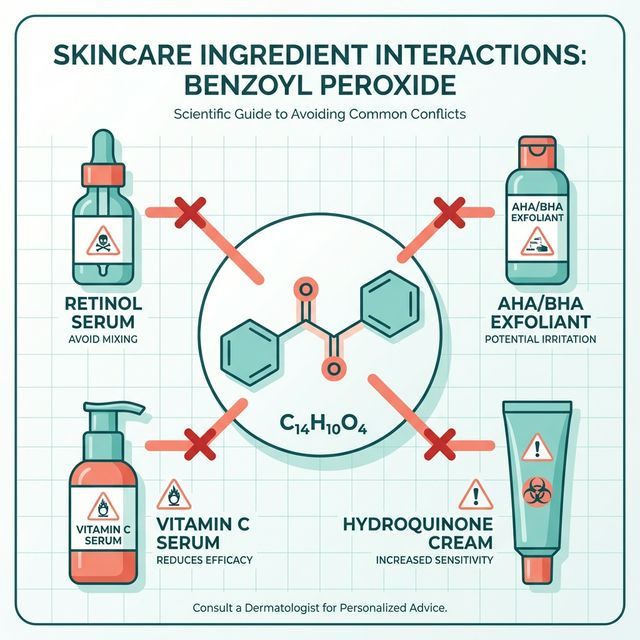
Benzoyl peroxide (BP) triggers 4 separate conflict rules in SkinGuard's engine, more than any other single ingredient group. It oxidizes retinol (reducing efficacy), causes extreme dryness with AHA/BHA, neutralizes vitamin C's brightening effect, and creates temporary skin staining with hydroquinone. The fix: never layer BP with other actives in the same routine. Use an AM/PM split or alternate days instead. One exception: Adapalene is chemically stable with BP.
📖 What Is Benzoyl Peroxide?
Benzoyl peroxide (BP) is an organic peroxide compound used in acne treatment since the 1930s. It works through two mechanisms: (1) it kills Cutibacterium acnes (the bacteria that cause inflammatory acne) by releasing reactive oxygen species on contact, and (2) it acts as a keratolytic agent, loosening dead skin cells inside pores. According to a review by Sagransky et al. (2009) in the Journal of Clinical and Aesthetic Dermatology (DOI: 10.1111/j.1365-4632.2009.04275.x), BP is one of the most effective topical acne treatments available, but its strongly oxidizing nature creates conflicts with several other popular skincare ingredients.
Why Does Benzoyl Peroxide Conflict With So Many Ingredients?
The answer is in BP's chemistry. Benzoyl peroxide is a powerful oxidizing agent, it works by generating free radicals (reactive oxygen species) that destroy bacterial cell membranes. This oxidation is what makes BP so effective against acne.
But the same oxidation doesn't stop at bacteria. According to Zaenglein et al. (2016) in the Journal of the American Academy of Dermatology (DOI: 10.1016/j.jaad.2015.12.037), BP's radical generation extends to other molecules on the skin, including the active compounds in your other skincare products. When BP oxidizes retinol, vitamin C, or hydroquinone, it chemically degrades them before they can deliver their intended benefits.
Additionally, BP is inherently drying. At standard concentrations (2.5–10%), it strips sebum and increases transepidermal water loss (TEWL). Layering it with exfoliating acids (AHA, BHA, LHA) that also disrupt the barrier creates a compounding dryness effect that can damage the stratum corneum. For those who need antimicrobial acne treatment without BP's oxidation conflicts, hypochlorous acid (HOCl) offers comparable efficacy with zero irritation and no ingredient conflicts.
SkinGuard's Conflict Engine covers all 4 BP interactions across 4 separate validated rules, the most of any single ingredient group in our database of 28,705 verified cosmetic substances.
SkinGuard's Conflict Data: BP × Everything
Here's how SkinGuard classifies every benzoyl peroxide conflict, pulled directly from our Conflict Engine rules:
| Combination | SkinGuard Rule | Severity | Risk Type |
|---|---|---|---|
| BP + Retinol / Tretinoin | RULE_03 | 🔴 HIGH | Potential Irritation + Possible Reduced Efficacy |
| BP + AHA (Glycolic/Lactic Acid) | RULE_04 | 🔴 HIGH | Extreme Dryness Warning |
| BP + BHA (Salicylic Acid) | RULE_04 | 🔴 HIGH | Extreme Dryness Warning |
| BP + LHA (Capryloyl Salicylic) | RULE_04 | 🔴 HIGH | Extreme Dryness Warning |
| BP + Pure Vitamin C (L-AA) | RULE_05 | 🟡 MEDIUM | Oxidation Risk (Reduced Brightening) |
| BP + Hydroquinone | RULE_06 | 🔴 HIGH | Temporary Skin Staining Risk |
Source: SkinGuard Conflict Engine v2.0, 18 validated rules covering RETINOIDS, AHA, BHA, LHA, PHA, Benzoyl Peroxide, Vitamin C, and more. Data from 28,705 cosmetic substance analyses.
SkinGuard flags BP with 3 HIGH and 1 MEDIUM-severity conflicts
The app detects BP × RETINOIDS (RULE_03), BP × AHA/BHA/LHA (RULE_04), BP × VITAMIN C (RULE_05), and BP × HYDROQUINONE (RULE_06). When any is detected, SkinGuard shows a severity-colored alert with the specific risk description and scheduling guidance.
Conflict #1: Benzoyl Peroxide + Retinol (RULE_03: HIGH)
This is the most misunderstood BP conflict. Many acne treatment guides recommend both BP and retinol, but layering them in the same routine undermines both ingredients.
According to research by Leyden et al. (2001) in the Journal of the American Academy of Dermatology (DOI: 10.1067/mjd.2001.113689), benzoyl peroxide's oxidizing action can degrade certain retinoid compounds, particularly tretinoin (all-trans retinoic acid). When applied simultaneously, BP breaks down tretinoin molecules on the skin surface before they penetrate to the target receptors in the dermis.
The result: you get the irritation of both ingredients (dryness, peeling, redness) but only a fraction of the retinoid's anti-aging and acne-clearing benefit.
The safe schedule: BP in the morning, retinoid in the evening. Or alternate days. BP on Monday/Wednesday/Friday, retinoid on Tuesday/Thursday/Saturday.
✅ The Adapalene Exception: Adapalene (brand name: Differin) is a synthetic retinoid with a different molecular structure that resists oxidation by benzoyl peroxide. According to Thiboutot et al. (2007) in the Journal of the American Academy of Dermatology (DOI: 10.1016/j.jaad.2006.12.010), the combination of adapalene 0.1% + BP 2.5% (sold as Epiduo) is one of the most effective topical acne treatments available. This is the one retinoid that is safe to layer with BP, but irritation can still occur, so introduce gradually.
Conflict #2: Benzoyl Peroxide + AHA/BHA/LHA (RULE_04: HIGH)
SkinGuard labels this conflict with an unmistakable name: "Extreme Dryness Warning."
BP already strips sebum and disrupts the lipid matrix of the stratum corneum. AHAs (glycolic acid, lactic acid) dissolve desmosomal bonds between corneocytes on the surface. BHA (salicylic acid) penetrates pores and strips sebum from within. Layering BP with any of these acids creates a triple assault on the skin barrier:
- BP oxidizes and dries the skin surface (radical generation + keratolysis)
- AHA/BHA dissolves the bonds holding remaining cells together (chemical exfoliation)
- The barrier collapses: TEWL spikes, ceramide levels drop, and the skin can't recover fast enough to maintain protection
According to a review in the International Journal of Dermatology by Del Rosso (2008), combining multiple barrier-disrupting agents without temporal separation is the primary cause of iatrogenic contact dermatitis in acne patients, meaning the treatment itself causes a new skin problem.
The visible result: raw, flaking skin that stings on contact with water, moisturizer, or even air. Recovery takes 7–14 days with a barrier-repair routine (ceramides, hyaluronic acid, petrolatum).
The safe schedule: BP in AM, acid exfoliant in PM. Or alternate days. Never layer them in the same routine. For a deeper guide on choosing between AHA, BHA, and PHA, see our complete acid exfoliation guide.
Conflict #3: Benzoyl Peroxide + Vitamin C (RULE_05: MEDIUM)
This conflict is about chemistry, not irritation. Unlike the HIGH-severity BP conflicts above, BP + Vitamin C is classified as MEDIUM because it doesn't cause barrier damage, it causes ingredient neutralization.
L-Ascorbic Acid (the most potent form of vitamin C) is an antioxidant. it donates electrons to neutralize free radicals. BP is an oxidant, it generates free radicals. When applied together, they cancel each other out. According to Farris (2005) in the Dermatologic Therapy journal (DOI: 10.1111/j.1529-8019.2005.00013.x), "topical antioxidants should not be combined with strong oxidizing agents as they neutralize each other on contact."
The result: your vitamin C serum does nothing. You still get the drying effects of BP, but zero brightening, anti-aging, or photoprotective benefit from the vitamin C. You're essentially wasting your most expensive product.
The safe schedule: Vitamin C in AM (it provides UV photoprotection during the day), BP in PM. Or alternate days. The vitamin C derivative MAP (Magnesium Ascorbyl Phosphate) is more oxidation-resistant than L-Ascorbic Acid, but SkinGuard still flags the combination as a precaution.
For the complete guide to all 4 vitamin C conflicts (including retinol, AHA/BHA, and copper peptides) see our Vitamin C mixing guide. For the niacinamide myth specifically, see our niacinamide + vitamin C myth article.
Conflict #4: Benzoyl Peroxide + Hydroquinone (RULE_06: HIGH)
This is the most visually alarming BP conflict. When BP and hydroquinone are applied together, a chemical reaction produces temporary orange-brown discoloration on the skin, the exact opposite of what hydroquinone is supposed to do (lighten dark spots).
According to Draelos (2007) in the Journal of Cosmetic Dermatology (DOI: 10.1111/j.1473-2165.2007.00302.x), the staining results from BP oxidizing hydroquinone into quinone compounds that bind to proteins in the stratum corneum. The discoloration is temporary (reverses within 2–5 days of discontinuation) but psychologically distressing, especially for patients already treating hyperpigmentation.
SkinGuard classifies this as HIGH severity with the advice: "Do not use in the same routine. Cleanse thoroughly between steps."
The safe schedule: BP in AM, hydroquinone in PM. Cleanse thoroughly between applications. Some dermatologists prescribe time-separated protocols where BP is used in the morning wash-off and hydroquinone is applied as a leave-on treatment at night , but even this requires at least 12 hours of separation.
The Safe Benzoyl Peroxide Routine: AM Only, Minimal Layering
Based on SkinGuard's conflict data and dermatological literature, the safest way to use BP is as a standalone AM active, the last active step before sunscreen:
| Step | AM Routine (with BP) | PM Routine (other actives) |
|---|---|---|
| 1 | Gentle cleanser (no AHA/BHA wash) | Double cleanse (oil + water-based) |
| 2 | Moisturizer (ceramides preferred) | Toner / essence (optional) |
| 3 | Benzoyl Peroxide 2.5–5% | Active treatment (retinol OR AHA OR vitamin C) |
| 4 | SPF 30+ sunscreen | Moisturizer |
⚠️ Concentration matters: According to a landmark study by Mills Jr. et al. (1986) in the Journal of the American Academy of Dermatology, BP at 2.5% is equally effective at killing C. acnes as 5% and 10% concentrations, but with significantly less irritation. Start at 2.5% and increase only if needed.
This schedule keeps BP physically separated from every conflicting ingredient by at least 8–12 hours, preventing the oxidation and barrier-disruption effects described above.
How SkinGuard Detects and Prevents BP Conflicts
SkinGuard's Conflict Engine runs 18 validated rules against your routine in real time. For benzoyl peroxide specifically, here's the detection workflow:
- Scan: You photograph your product labels or search by name. SkinGuard's parser identifies benzoyl peroxide across all naming variants. BP, BPO, benzoperoxide, dibenzoyl peroxide, in our database of 28,705 verified substances
- Cross-reference: The engine checks every other product in your routine. If any RETINOID, AHA, BHA, LHA, VITAMIN_C_PURE, or HYDROQUINONE ingredient is present, the corresponding rule (RULE_03 through RULE_06) triggers
- Alert: A severity-colored alert appears, orange for HIGH, yellow for MEDIUM, with the specific conflict name, risk description, and scheduling advice
- Guide: The app suggests the AM/PM split or alternate-day schedule specific to each conflict pair, and monitors for re-introduced conflicts when you add new products
No guesswork. No accidentally layering your BP wash with a glycolic acid toner. No discovering the orange hydroquinone stain after it's already happened.
Frequently Asked Questions
Can you use benzoyl peroxide and retinol together?
Not in the same routine. Benzoyl peroxide oxidizes retinol, reducing its efficacy and increasing irritation. Use BP in AM and retinol in PM, or alternate days. Exception: Adapalene (Differin) is chemically stable with BP.
Can you use benzoyl peroxide and vitamin C together?
Avoid layering them simultaneously. BP oxidizes pure L-Ascorbic Acid on the skin, reducing brightening benefits. SkinGuard classifies this as MEDIUM severity. Use vitamin C in AM and BP in PM.
Why does benzoyl peroxide stain skin with hydroquinone?
BP and hydroquinone undergo a chemical reaction that produces temporary orange-brown discoloration on the skin. Never apply them in the same routine. Cleanse thoroughly between uses and separate by at least 12 hours.
Can you use benzoyl peroxide with salicylic acid?
SkinGuard flags this as HIGH severity with "Extreme Dryness Warning." Both strip the skin barrier through different mechanisms. If you use both, apply BP in AM and BHA in PM, or alternate days. Never layer them.
What is the safest way to use benzoyl peroxide?
Use BP in the morning as the last active step before sunscreen. Keep the concentration at 2.5–5% (equally effective as 10% with less irritation). Avoid layering with any other active ingredient in the same routine.
📚 References
- Sagransky, M., et al. (2009). Benzoyl peroxide: a review of its current use in the treatment of acne vulgaris. Journal of Clinical and Aesthetic Dermatology, 2(3), 26–36. DOI: 10.1111/j.1365-4632.2009.04275.x
- Zaenglein, A. L., et al. (2016). Guidelines of care for the management of acne vulgaris. Journal of the American Academy of Dermatology, 74(5), 945–973. DOI: 10.1016/j.jaad.2015.12.037
- Leyden, J. J., et al. (2001). Comparison of the efficacy and safety of a combination topical gel formulation of benzoyl peroxide and clindamycin. Journal of the American Academy of Dermatology, 45(2), 233–240. DOI: 10.1067/mjd.2001.113689
- Thiboutot, D. M., et al. (2007). Adapalene-benzoyl peroxide, a fixed-dose combination for the treatment of acne vulgaris. Journal of the American Academy of Dermatology, 57(5), 791–799. DOI: 10.1016/j.jaad.2006.12.010
- Farris, P. K. (2005). Topical vitamin C: a useful agent for treating photoaging and other dermatologic conditions. Dermatologic Surgery, 31(s1), 814–818. DOI: 10.1111/j.1529-8019.2005.00013.x
- Draelos, Z. D. (2007). Skin lightening preparations and the hydroquinone controversy. Journal of Cosmetic Dermatology, 6(1), 2–5. DOI: 10.1111/j.1473-2165.2007.00302.x
⚕️ Medical Disclaimer: This article is for educational purposes only and does not replace medical advice. Consult a board-certified dermatologist before changing your skincare routine, especially if you use prescription acne medications. SkinGuard is a cosmetic analysis tool, not a medical device.