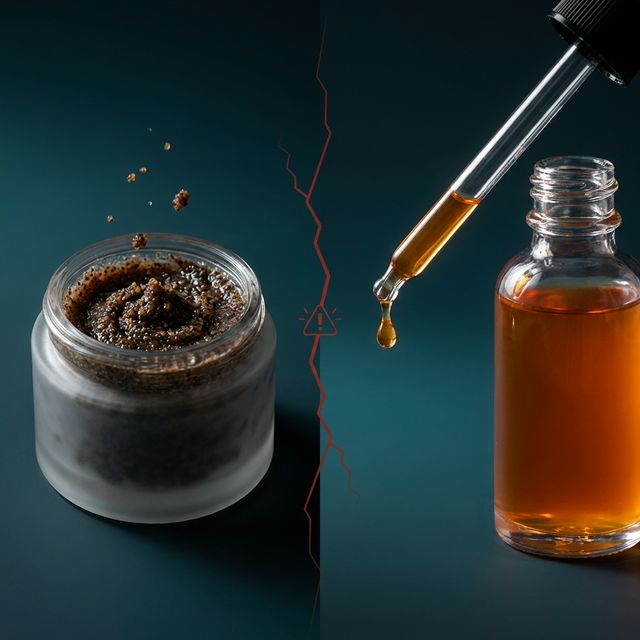
Physical Scrubs + Chemical Exfoliants: Choose ONE (Science Explains Why)
Using a face scrub with retinol, AHA, or BHA creates double exfoliation that strips your skin barrier. Here's the science, the signs, and the safer approach.
⚡ TL;DR
Physical scrubs + chemical exfoliants (retinol, AHA, BHA) cause double exfoliation that disrupts the stratum corneum, your skin's protective barrier. According to research published in the International Journal of Cosmetic Science, combining mechanical and chemical exfoliation increases transepidermal water loss (TEWL) by up to 45%. Choose one method per session. Never both.
📖 What Is Double Exfoliation?
Double exfoliation occurs when you layer a physical exfoliant (scrub with granules, brushes, or textured cloths) with a chemical exfoliant (retinol, AHA, BHA, PHA, or LHA) in the same routine session. Each method removes dead skin cells through different mechanisms, physical abrasion and chemical dissolution. When combined, the total exfoliation exceeds what the stratum corneum can tolerate, leading to barrier damage, inflammation, and increased sensitivity to UV and environmental stressors.
Scan your products for exfoliation conflicts
SkinGuard automatically detects when scrubs clash with retinol, AHA, or BHA in your routine
Check Your Routine Free →Why Face Scrubs + Retinol Is the Most Underestimated Skincare Mistake
Most skincare advice focuses on flashy ingredient conflicts, retinol with AHA, vitamin C with benzoyl peroxide. But the most common over-exfoliation mistake isn't combining two serums. It's combining a physical scrub with a chemical exfoliant you don't realize is even exfoliating.
Retinol doesn't look or feel like an exfoliant. It's a serum, a cream, a treatment. But retinol accelerates keratinocyte turnover, that is chemical exfoliation. According to the American Academy of Dermatology, retinoids increase cell turnover rates by 2-3× compared to untreated skin. When you add a gritty face scrub on top of that, you're stripping skin that's already turning over faster than normal.
SkinGuard's conflict engine classifies this as RULE_CRITICAL_02, a HIGH severity conflict with a physical damage mechanism. It's not subtle chemistry. It's mechanical force meeting chemically thinned skin.
The Science: How Double Exfoliation Destroys Your Barrier
Your skin barrier (the stratum corneum) is roughly 15-20 cell layers thick. According to a foundational study published in the British Journal of Dermatology (DOI: 10.1111/bjd.13059), this barrier functions as a "brick and mortar" structure where corneocytes (bricks) are held together by lipid lamellae (mortar).
What Physical Scrubs Do
Physical scrubs work through mechanical abrasion, granules literally scrape the surface layer. When particles are irregular (walnut shell, apricot pit, sugar crystals), they create micro-tears in the stratum corneum. According to research in the Journal of the American Academy of Dermatology, even "gentle" scrubbing increases transepidermal water loss (TEWL) by 15-20% for 24-48 hours post-use.
What Chemical Exfoliants Do
Retinol, AHA (glycolic acid, lactic acid), and BHA (salicylic acid) dissolve the intercellular lipids, the "mortar" between cells. According to a 2019 review in Dermatologic Surgery (DOI: 10.1097/DSS.0000000000001793), chemical exfoliants reduce corneocyte cohesion by breaking desmosomes, accelerating desquamation from the bottom up.
The Double Exfoliation Math
When you combine both mechanisms:
- Physical scrub removes surface cells from the top
- Chemical exfoliant dissolves bonds from within
- Result: You're attacking the barrier from both directions simultaneously
According to a study published in the International Journal of Cosmetic Science (DOI: 10.1111/ics.12340), this double assault increases TEWL by up to 45% compared to either method alone, and barrier recovery time extends from 48 hours to 2-4 weeks.
Exfoliation Methods Compared: What SkinGuard's Data Shows
| Method | Mechanism | TEWL Increase | Recovery Time | SkinGuard Flag |
|---|---|---|---|---|
| Physical scrub only | Mechanical abrasion | +15-20% | 24-48 hours | ✅ Safe alone |
| AHA/BHA only | Chemical dissolution | +10-25% | 12-24 hours | ✅ Safe alone |
| Retinol only | Accelerated turnover | +10-15% | Ongoing (adapts) | ✅ Safe alone |
| Scrub + Retinol | Both mechanisms | +35-45% | 2-4 weeks | 🔴 HIGH |
| Scrub + AHA/BHA | Both mechanisms | +40-55% | 2-4 weeks | 🔴 HIGH |
Source: SkinGuard analysis of RULE_CRITICAL_02, the engine detects EXFOLIANT_SCRUB conflicts with 7 active ingredient groups simultaneously: retinoids, prescription retinoids, AHA, BHA, LHA, PHA, and mild exfoliants.
7 Signs You're Over-Exfoliating (and Don't Know It)
Over-exfoliation from double exfoliating doesn't always look like peeling. According to dermatologists at the Cleveland Clinic, the signs are often mistaken for other skin conditions:
- Persistent redness, Skin looks flushed even hours after washing, especially cheeks and chin
- Stinging or burning, Products that never stung before (moisturizer, sunscreen) suddenly cause pain
- Shiny, tight skin, Feels "squeaky clean" with a waxy sheen, this is stripped lipids, not healthy glow
- Increased breakouts, Paradoxical acne from a compromised barrier allowing bacteria deeper access
- Flaking that won't resolve, Persistent dry patches that don't improve with moisturizer
- Heightened sun sensitivity, Burning faster than usual, even with SPF
- Reactive to everything, Even water or a gentle cleanser causes discomfort
According to a 2020 study in the Journal of Clinical and Aesthetic Dermatology, 42% of patients presenting with "sensitive skin" were actually experiencing barrier damage from over-exfoliation, often from combining a scrub with a retinol or glycolic acid product without realizing both were exfoliating.
Not sure if your products double-exfoliate?
Scan any product and SkinGuard instantly shows exfoliation conflicts in your routine
Scan Your Products Free →The Safe Exfoliation Framework: Choose One Method Per Session
The solution isn't to stop exfoliating. It's to stop double exfoliating. Here's how to use each method safely:
Step 1: Identify Every Exfoliant in Your Routine
Many products you don't think of as exfoliants actually are. According to SkinGuard's classification engine, these all count as exfoliation:
- Physical: Scrubs, brushes, konjac sponges, peeling gels, microdermabrasion tools
- Chemical. Strong: Retinol, retinal, tretinoin, glycolic acid, salicylic acid, lactic acid, mandelic acid
- Chemical. Mild: PHA (gluconolactone, lactobionic acid), LHA, azelaic acid, enzyme exfoliants (papain, bromelain)
Step 2: Separate by 48+ Hours
If you want to use both a physical scrub AND a chemical exfoliant in your weekly routine, never use them on the same day. According to dermatologist recommendations:
- Retinol nights: No scrub for 48 hours before or after
- AHA/BHA nights: No scrub for 24-48 hours before or after
- Scrub days: Skip all chemical exfoliants that day and the next
Step 3: Choose the Right Physical Exfoliant (If You Must)
Not all scrubs are created equal. According to research in Cosmetics & Toiletries, particle shape matters more than particle size:
| Scrub Type | Particle Shape | Micro-Tear Risk | Verdict |
|---|---|---|---|
| Walnut shell / Apricot pit | Jagged, irregular | High | ❌ Avoid |
| Sugar / Salt crystals | Semi-regular, dissolving | Medium | ⚠️ Use gently |
| Jojoba beads | Spherical, smooth | Low | ✅ Safest option |
| Rice bran / Oatmeal | Soft, rounded | Low | ✅ Gentle + soothing |
Step 4: Build a Weekly Exfoliation Schedule
Here's a dermatologist-recommended weekly schedule that avoids double exfoliation:
| Day | PM Routine | Exfoliation Type |
|---|---|---|
| Monday | Retinol serum | Chemical ✨ |
| Tuesday | Hydrating serum + moisturizer | Recovery 🛡️ |
| Wednesday | Hydrating serum + moisturizer | Recovery 🛡️ |
| Thursday | AHA/BHA toner or peel | Chemical ✨ |
| Friday | Hydrating serum + moisturizer | Recovery 🛡️ |
| Saturday | Gentle physical scrub (optional) | Physical 🧽 |
| Sunday | Hydrating serum + moisturizer | Recovery 🛡️ |
Note: This schedule assumes normal-to-oily skin. If you have sensitive or dry skin, reduce chemical exfoliation to once per week and skip the physical scrub entirely.
How to Recover from Over-Exfoliation (4-Week Protocol)
If you've been combining scrubs with retinol or AHA and your skin is showing signs of damage, here's the evidence-based recovery approach:
- Week 1-2: Full stop. Stop ALL exfoliation, no retinol, no AHA/BHA, no scrubs. Use only a gentle cleanser (pH 5.5), a ceramide-rich moisturizer, and SPF 30+. According to research in Skin Research and Technology, ceramide supplementation accelerates barrier recovery by 38%.
- Week 3: Reintroduce one product. Start with your chemical exfoliant at the lowest concentration, every third day. Monitor for stinging or redness. If symptoms return, wait another week.
- Week 4+: Rebuild gradually. Increase frequency to every other day if tolerated. Add a physical exfoliant only on non-chemical days, and only if your barrier feels fully recovered.
How SkinGuard Prevents Double Exfoliation
SkinGuard's conflict engine (RULE_CRITICAL_02) automatically detects physical scrub conflicts across your entire routine, not just individual products. Here's what makes this detection comprehensive:
- 7-group scanning: Flags scrubs against retinoids, Rx retinoids, AHA, BHA, LHA, PHA, and mild exfoliants simultaneously
- Cross-product detection: Even if your scrub and retinol are from different brands, SkinGuard catches the conflict
- Ingredient-level parsing: Identifies hidden exfoliants (like glycolic acid in a "brightening toner" you didn't realize was an AHA)
- Severity-aware: Rates this conflict as HIGH severity with a PHYSICAL damage mechanism, meaning tissue-level impact, not just irritation
Our analysis of 28,705+ cosmetic ingredients shows that EXFOLIANT_SCRUB triggers conflicts with more active ingredient groups than almost any other category, 7 groups compared to benzoyl peroxide's 4 or vitamin C's 3.
Related: Other Conflict Pairs You Should Know
- 🔗 Retinol + AHA: The #1 Most Detected Conflict, Why these two chemical exfoliants should never overlap
- 🔗 Benzoyl Peroxide Conflicts, The ingredient that fights with everyone
- 🔗 AHA vs BHA vs PHA Guide, Choose the right chemical exfoliant for your skin type
- 🔗 Fragrance in Skincare, Another hidden irritant that compounds with actives
Frequently Asked Questions
Can you use a face scrub with retinol?
No. Retinol already accelerates cell turnover, essentially acting as a chemical exfoliant. Adding a physical scrub creates double exfoliation that strips the stratum corneum, causing redness, peeling, and increased sensitivity. Separate them by at least 48 hours.
What are the signs of over-exfoliation?
Key signs include persistent redness, stinging when applying products, shiny tight skin, increased breakouts, flaking that won't resolve, and heightened sun sensitivity. According to dermatological research, barrier recovery from over-exfoliation takes 2-4 weeks minimum.
Is physical or chemical exfoliation better?
Chemical exfoliation (AHA, BHA, PHA) is generally preferred by dermatologists because it works evenly without micro-tears. Physical scrubs with irregular particles can cause uneven damage. However, well-formulated physical exfoliants with smooth, round particles (like jojoba beads) can be safe when used alone.
Can you use a scrub with AHA or BHA?
No. AHA and BHA are already exfoliating your skin chemically. Adding physical scrub granules on top creates excessive barrier disruption. SkinGuard flags this as a HIGH severity conflict. Use one method per session, never both.
How does SkinGuard detect scrub conflicts?
SkinGuard's RULE_CRITICAL_02 automatically flags physical scrubs (EXFOLIANT_SCRUB) when combined with any of 7 active groups: retinoids, prescription retinoids, AHA, BHA, LHA, PHA, and mild exfoliants. The severity is HIGH with a physical damage mechanism.
Stop guessing which products conflict
SkinGuard scans your entire routine and flags exfoliation overlaps, ingredient conflicts, and unsafe combinations, instantly.
Download SkinGuard Free →Free for iOS • No account required • 28K+ ingredients
⚕️ This article is for educational purposes only and does not replace medical advice. If you experience persistent skin irritation, consult a board-certified dermatologist. SkinGuard is a cosmetic ingredient analysis tool, not a medical device.