Hypochlorous Acid for Skin: What Dermatology Research Actually Shows
Your immune system already makes hypochlorous acid to fight infections. Clinical studies show this same molecule reduces acne as effectively as benzoyl peroxide, calms eczema itch in 72 hours, and destroys antibiotic-resistant biofilms — with zero irritation. Here is everything dermatology research tells us about using HOCl on skin.
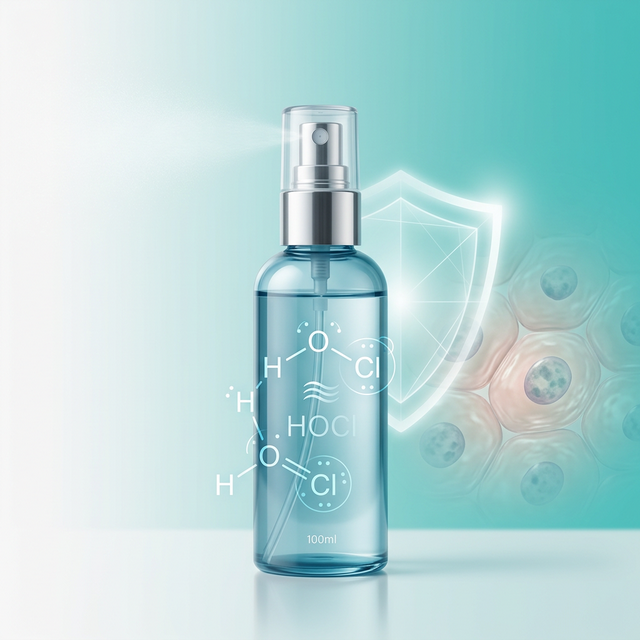
⚡ TL;DR
Hypochlorous acid (HOCl) is an antimicrobial molecule your immune system already produces. Clinical evidence shows it reduces acne lesions comparably to benzoyl peroxide, calms eczema itch within 72 hours, and fights antibiotic-resistant bacteria — all without irritation. Use it as a pre-treatment mist at 50–200 ppm, pH 3.5–5.5.
📖 What Is Hypochlorous Acid?
Hypochlorous acid (HOCl) is a naturally occurring molecule produced by white blood cells (neutrophils) to fight infections. Its INCI name is simply Hypochlorous Acid. In skincare, it is manufactured through electrolysis of salt water, creating a stabilized solution at very low concentrations (0.005–0.02%). Despite sharing a chemical family with bleach (sodium hypochlorite), skincare-grade HOCl operates at a completely different concentration and pH — making it gentle enough for daily use on sensitive skin.
Check Your HOCl Product's Ingredient Safety
SkinGuard scans your product label and identifies HOCl concentration, pH compatibility, and flags any ingredient conflicts in your routine.
Scan Your Product Free →How Your Body Already Makes HOCl
Every time your immune system fights an infection, it deploys hypochlorous acid. Here is the exact biochemical pathway:
According to a comprehensive review by Block and Rowan (2020) published in the Journal of Oral and Maxillofacial Surgery, neutrophils produce HOCl through the myeloperoxidase-H₂O₂-chloride system during what is called the "oxidative burst." When pathogens invade, neutrophils release the enzyme myeloperoxidase, which combines hydrogen peroxide with chloride ions to generate HOCl — a potent antimicrobial agent.
This is not a gentle process. HOCl kills bacteria, fungi, and viruses through oxidative damage to their proteins, DNA, and lipid membranes. It punctures microbial cell walls in a way that bacteria cannot develop resistance to — unlike conventional antibiotics.
Skincare products replicate this molecule through electrolysis of a saline solution, producing stabilized HOCl at concentrations safe for topical application. The result is a molecule your skin already recognizes as a defense mechanism.
What the Science Shows HOCl Does for Skin
Acne: Comparable to Benzoyl Peroxide, Without the Dryness
One of the most compelling uses for HOCl is acne treatment. According to Del Rosso and Bhatia (2018) in the Journal of Clinical and Aesthetic Dermatology, review evidence suggests HOCl demonstrates comparable efficacy to benzoyl peroxide in reducing inflammatory acne lesions — with significantly better tolerability. No bleaching of fabrics, no excessive dryness, no peeling.
A randomized controlled trial by Panichcutt et al. (2021) published in Dermatologic Practical & Conceptual confirmed that topical 0.005% sodium hypochlorite solution significantly reduced the total number of papules and pustules in mild-to-moderate acne compared to placebo over one month of treatment, applied three times daily.
The antimicrobial mechanism is particularly relevant: HOCl directly kills Cutibacterium acnes (the bacterium driving inflammatory acne) while simultaneously reducing the inflammatory response — addressing both the cause and the symptoms.
Eczema & Atopic Dermatitis: Calms Itch in 72 Hours
According to an investigator-blinded randomized study by Berman and Nestor (2017) published in SKIN: The Journal of Cutaneous Medicine, 73.7% of subjects treated with hypochlorous acid experienced a reduction in itching within 72 hours, compared to only 30.0% in the untreated control group.
Why does this work? Eczema flares are frequently triggered by Staphylococcus aureus colonization on the skin. HOCl reduces S. aureus colony counts without disrupting the beneficial skin microbiome — a significant advantage over broad-spectrum antibiotics. The American Academy of Dermatology (AAD) recognizes HOCl sprays as a practical alternative to dilute bleach baths for eczema management.
For parents managing childhood eczema, HOCl is particularly appealing: it is non-stinging, fragrance-free (in pure formulations), and can be sprayed directly onto irritated skin without the bathing logistics.
Wound Healing & Post-Procedure Recovery
HOCl has been FDA-cleared for wound care under 510(k) regulations. According to Dissemond (2020) in the Journal of Wound Care, HOCl provides significant benefits in wound bed preparation by disrupting bacterial biofilms — the protective shields that make wound infections resistant to antibiotics.
Dermatologists increasingly recommend HOCl sprays after cosmetic procedures like chemical peels, microneedling, and laser treatments. The logic is straightforward: the skin is temporarily compromised and infection-prone. HOCl provides antimicrobial protection without the irritation potential of acids or alcohols.
Rosacea & General Inflammation
According to Del Rosso and Bhatia's review, HOCl exhibits anti-inflammatory properties by neutralizing reactive oxygen species (ROS) and inhibiting pro-inflammatory mediators including histamine and leukotriene B4 (LTB4). For rosacea sufferers, this translates to reduced redness and fewer inflammatory flares without the stinging or flushing that many actives provoke.
| Condition | Evidence Level | Key Finding | Source |
|---|---|---|---|
| Acne (mild-moderate) | RCT | Reduces papules/pustules vs placebo | Panichcutt et al. 2021 |
| Acne (vs BP) | Review | Comparable efficacy, better tolerance | Del Rosso & Bhatia 2018 |
| Atopic dermatitis | Randomized | 73.7% itch reduction in 72h | Berman & Nestor 2017 |
| Wound care | Review | Biofilm disruption, faster healing | Block & Rowan 2020 |
| Wound cleansing | Review | Wound bed preparation benefits | Dissemond 2020 |
The Chemistry You Need to Know
Understanding three numbers will help you evaluate any HOCl product: concentration, pH, and shelf life.
Concentration: More Is Not Better
Skincare-grade HOCl should be between 50 and 200 ppm (0.005–0.02%). This concentration is thousands of times lower than household disinfectants. According to Block and Rowan's review, higher concentrations do not improve antimicrobial efficacy for skin applications but do increase irritation risk.
pH: The Critical Factor
HOCl only exists as the dominant species at pH 3.5–5.5. This science matters because:
- Below pH 3: Risk of chlorine gas formation — unsafe
- pH 3.5–5.5: HOCl is the dominant antimicrobial form ✅
- Above pH 7.5: HOCl converts to sodium hypochlorite (NaOCl) — essentially bleach
The optimal skincare pH range (3.5–5.5) also aligns with the skin's natural acid mantle, which means properly formulated HOCl products support rather than disrupt the skin barrier.
Shelf Life: How to Tell If Your HOCl Has Expired
HOCl is inherently unstable. Most stabilized products last 6–12 months unopened. Once opened, potency declines faster. Here are the signs of degradation:
- Faint chlorine scent = still active ✅
- Completely odorless = likely degraded ❌
- Yellow or brown color = oxidized, discard immediately ❌
Store your HOCl product in a cool, dark place. Avoid leaving it in a sunny bathroom — UV light accelerates decomposition.
| Factor | Optimal | Too Low | Too High |
|---|---|---|---|
| Concentration | 50–200 ppm | Ineffective | Skin irritation |
| pH | 3.5–5.5 | Chlorine gas risk | Converts to bleach |
| Temperature | Room temp / cool | N/A | Faster degradation |
| Light exposure | Dark / opaque bottle | N/A | UV breaks down HOCl |
How to Use HOCl in Your Skincare Routine
HOCl works best as a pre-treatment mist applied after cleansing and before serums. Here is a step-by-step guide:
Step 1: Cleanse
Wash your face with a gentle cleanser to remove surface debris and excess oil.
Step 2: Spray HOCl Mist
Hold the bottle 6–8 inches from your face and apply 2–3 pumps. Let it absorb naturally.
Step 3: Wait 60 Seconds
This is the key step. Allow HOCl to dry completely before applying the next layer. This ensures full antimicrobial contact time.
Step 4: Apply Serum
Layer your serums — niacinamide or hyaluronic acid work well with HOCl.
Step 5: Moisturize
Apply moisturizer — ceramides are ideal for barrier support after HOCl.
Step 6: SPF (AM Only)
Apply sunscreen in the morning — see our mineral vs chemical sunscreen guide.
What NOT to Layer With HOCl
HOCl is an oxidizing agent. This means it can deactivate certain ingredients. Avoid layering with:
🔴 Avoid Together
- Vitamin C (L-Ascorbic Acid) — HOCl oxidizes ascorbic acid, rendering both ineffective
- AHA/BHA exfoliants — pH conflict combined with irritation stacking (acid guide)
- Retinoids — Combined irritation risk when the barrier is compromised
- Benzoyl peroxide — Both are oxidizers; redundant, not synergistic
- Copper peptides — Oxidation risk reduces peptide efficacy
✅ Safe to Combine
- Niacinamide — complements anti-inflammatory activity
- Hyaluronic acid — provides hydration without conflicts
- Ceramides — barrier support pairs perfectly
- Centella Asiatica (CICA) — synergistic soothing
- Aloe vera — gentle, anti-inflammatory base
Scan Your Routine for HOCl Conflicts
SkinGuard checks 150+ ingredient interaction rules. Scan your HOCl mist alongside your existing serums to flag conflicts before they cause problems.
Scan Your Routine Free →Who Should (and Shouldn't) Use HOCl
✅ Ideal Candidates
- Acne-prone skin — gentler alternative to benzoyl peroxide
- Eczema and atopic dermatitis — reduces S. aureus and calms itch
- Post-procedure recovery — safe antimicrobial for compromised skin
- Sensitive skin — non-stinging, fragrance-free protection
- Rosacea — anti-inflammatory without triggering redness
⚠️ Use with Caution
- Chlorine sensitivity or allergy — rare but possible; patch test first
- Multiple strong actives — adding another active may overwhelm the skin
- Degraded product — expired HOCl provides zero benefit and may irritate
How SkinGuard Helps You Use HOCl Safely
SkinGuard's ingredient database covers 28,705 verified substances, including HOCl and its common formulation partners. The conflict detection engine checks 150+ ingredient interaction rules to ensure your entire routine works together — not against itself.
Before adding a new HOCl mist to your routine, scan it alongside your existing serums. SkinGuard will flag potential conflicts like HOCl + Vitamin C or HOCl + retinoids before they cause problems.
Download SkinGuard — Free Ingredient Scanner
Scan any skincare product to check ingredient safety, detect conflicts, and build a routine that works. 28,705+ substances indexed.
Download SkinGuard Free →Frequently Asked Questions About Hypochlorous Acid
Is hypochlorous acid safe for skin?+
Yes. HOCl is produced naturally by your immune system and is FDA-cleared for wound care. At skincare concentrations (50-200 ppm), it is non-irritating and safe for sensitive skin, including children.
Can I use hypochlorous acid with vitamin C?+
No. HOCl is an oxidizer that degrades L-ascorbic acid, making both ingredients ineffective. Use them at different times or alternate days.
How often should I use hypochlorous acid?+
Most dermatologists recommend once or twice daily. Apply as a mist after cleansing and before serums. For acne or eczema flares, twice daily is common.
Does hypochlorous acid expire?+
Yes. HOCl degrades from light, heat, and air exposure. Most products last 6-12 months unopened. If it loses its faint chlorine scent or turns yellow, it has expired.
Is hypochlorous acid the same as bleach?+
No. Bleach is sodium hypochlorite at high concentration and high pH. Skincare HOCl is 50-200 ppm at pH 3.5-5.5, thousands of times more dilute than household bleach.
Related Articles
⚕️ Disclaimer: This article is for educational purposes only and does not replace medical advice. The studies cited have specific methodologies and limitations. Individual results vary based on skin type, product formulation, and concurrent treatments. Consult a board-certified dermatologist for personalized skincare recommendations, especially for conditions like eczema, rosacea, or moderate-to-severe acne.