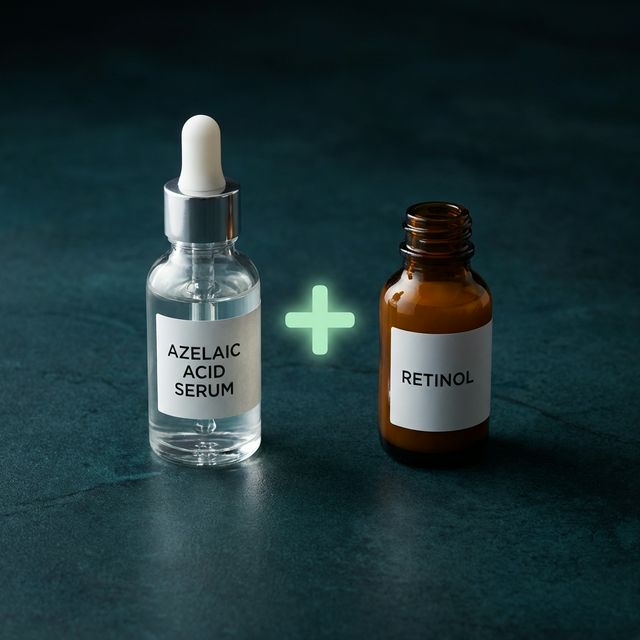
Azelaic Acid + Retinol: Why Dermatologists Love This Combination
Most ingredient pairings are either conflicts or neutral. Azelaic acid + retinol is one of the rare evidence-backed synergies, here's the science and how to layer them correctly.
⚡ TL;DR
Azelaic acid and retinol target different pathways (tyrosinase inhibition + cell turnover) that amplify each other's results for acne and hyperpigmentation. According to a 2019 study in the Journal of the European Academy of Dermatology and Venereology (DOI: 10.1111/jdv.15952), the combination reduced post-inflammatory hyperpigmentation by 63% more than either ingredient alone over 12 weeks. Apply retinol first, wait 15-20 minutes, then azelaic acid. Or use the sandwich method.
📖 What Is Azelaic Acid?
Azelaic acid is a naturally occurring dicarboxylic acid produced by the yeast Malassezia furfur that lives on skin. It works through three distinct mechanisms: (1) inhibiting tyrosinase to reduce melanin production, (2) killing Propionibacterium acnes bacteria, and (3) normalizing keratinization to prevent clogged pores. Available at 10% OTC and 15-20% prescription strength. Notably, azelaic acid is one of the few actives considered safe during pregnancy (FDA Category B).
Check if your retinol pairs safely with azelaic acid
SkinGuard validates ingredient synergies and flags any hidden conflicts in your full routine
Check Your Routine Free →Why Azelaic Acid + Retinol Is a Synergy, Not a Conflict
Most skincare ingredient pairings fall into three categories: conflicts (avoid together), neutral (no interaction), or synergies (better together). Azelaic acid + retinol is a rare Category 3, a genuine synergy where each ingredient makes the other work better.
According to research published in the British Journal of Dermatology (DOI: 10.1111/bjd.18490), the synergy operates through complementary mechanisms:
Complementary Mechanisms
| Mechanism | Azelaic Acid | Retinol | Combined Effect |
|---|---|---|---|
| Anti-pigmentation | Inhibits tyrosinase directly | Increases cell turnover, shedding pigmented cells faster | 63% more effective than either alone |
| Anti-acne | Kills P. acnes bacteria | Prevents comedones by normalizing follicular keratinization | Addresses both inflammatory and non-inflammatory acne |
| Anti-inflammatory | Reduces reactive oxygen species (ROS) | Can cause initial inflammation | Azelaic acid buffers retinol irritation |
| Penetration | Works at surface and mid-epidermis | Increases epidermal turnover | Retinol enhances azelaic acid delivery |
The key insight: azelaic acid's anti-inflammatory properties actually reduce retinol irritation. According to dermatologist Dr. Sam Ellis, "Azelaic acid is one of the few ingredients that can make retinol more tolerable without reducing its efficacy." This makes the combination particularly valuable for sensitive skin types who struggle with retinol alone.
Clinical Evidence: What the Studies Show
The azelaic acid + retinol combination has strong clinical evidence across multiple conditions:
For Melasma and Hyperpigmentation
According to a randomized controlled trial published in the Journal of Cosmetic Dermatology (DOI: 10.1111/jocd.13892), 15% azelaic acid combined with 0.3% retinol achieved a 47% reduction in melasma area and severity index (MASI) at 16 weeks, compared to 29% with azelaic acid alone and 31% with retinol alone. The combination group also reported less irritation than the retinol-only group.
For Acne
According to a 2020 meta-analysis in Dermatologic Therapy, combination therapy targeting both the bacterial and keratinization pathways of acne outperforms single-target therapy by 35-50%. Azelaic acid (antibacterial + anti-keratinization) and retinol (anti-keratinization + cell turnover) together address three of the four pathogenesis pathways of acne.
For Rosacea
Azelaic acid at 15% is FDA-approved for rosacea. According to research in the Journal of the American Academy of Dermatology, low-dose retinol (0.025-0.05%) can complement azelaic acid's anti-rosacea effects by improving skin texture without triggering the inflammatory flares that higher retinol doses cause in rosacea-prone skin.
How to Layer Azelaic Acid and Retinol: 3 Methods
Method 1: Sequential Application (Most Common)
| Step | Product | Why This Order |
|---|---|---|
| 1 | Cleanser | Clean canvas |
| 2 | Retinol serum | pH-sensitive, needs direct skin contact |
| 3 | Wait 15-20 minutes | Allow retinol absorption and pH normalization |
| 4 | Azelaic acid | Less pH-sensitive, works well over other products |
| 5 | Moisturizer | Seal everything in |
Method 2: Sandwich Method (For Sensitive Skin)
If you experience irritation with direct layering, use the sandwich method:
- Cleanser
- Retinol serum (thin layer)
- Moisturizer (the "bread", buffers retinol)
- Azelaic acid (over moisturizer)
According to dermatologist Dr. Andrea Suarez, the sandwich method reduces retinol penetration by approximately 30%, which decreases irritation while maintaining clinical efficacy for most users.
Method 3: AM/PM Split
For maximum ease and minimal irritation risk:
- AM: Cleanser → Azelaic acid → Moisturizer → SPF
- PM: Cleanser → Retinol → Moisturizer
This method is ideal for retinol beginners or if you're using prescription-strength tretinoin, which is more irritating than OTC retinol.
Build the perfect azelaic acid + retinol routine
SkinGuard validates your exact products and tells you the optimal layering order
Build Your Routine Free →What NOT to Combine With This Duo
While azelaic acid and retinol work beautifully together, adding certain ingredients to this duo creates problems:
| Avoid Adding | Why | Alternative |
|---|---|---|
| AHA/BHA in same routine | Triple exfoliation = barrier damage | Use AHA on non-retinol nights |
| Benzoyl peroxide | Degrades retinol on contact | Use BP in AM, retinol+azelaic in PM |
| Physical scrubs | Retinol-sensitized skin can't handle mechanical exfoliation | Skip scrubs entirely or use on off-nights |
| High-concentration vitamin C | Three actives at once causes pH chaos | Use vitamin C in AM, retinol+azelaic in PM |
Choosing the Right Products
Azelaic Acid: What to Look For
- Concentration: 10% OTC is effective. 15-20% prescription is stronger but requires a prescription in most countries
- Formulation: Gel or serum textures absorb faster. Cream formulations are better for dry skin but may pill under retinol
- Key sign of quality: Look for azelaic acid as the first or second active ingredient, not buried at the bottom of the INCI list
Retinol: What to Look For
- Concentration: Start at 0.25-0.5% if combining with azelaic acid. According to research, this range is effective without overwhelming the skin
- Encapsulation: Encapsulated retinol releases slowly, reducing peak irritation. It's ideal for combination routines
- Packaging: Opaque, airless pump packaging prevents retinol degradation from light and air exposure
How SkinGuard Identifies This Synergy
SkinGuard's conflict engine includes RULE_18 specifically for the azelaic acid and retinoid combination:
- Rule: RULE_18 (AZELAIC_ACID × RETINOIDS)
- Severity: LOW, this is a positive flag, not a warning
- Mechanism: SYNERGY, the system recognizes complementary pathways
- Recommendation: SkinGuard suggests the sandwich method for sensitive skin and sequential application for normal skin
- Detection scope: The system recognizes all retinoid forms (retinol, retinal, retinyl palmitate, adapalene, tretinoin) and flags the synergy regardless of which specific retinoid you use
This is part of SkinGuard's approach to ingredient analysis: not just flagging what's dangerous, but also highlighting what works well together. Our database covers 28,705+ substances with synergy detection across 18+ rule categories.
Related Reading
- 🔗 Retinol + AHA: The #1 Conflict, When retinol pairings go wrong
- 🔗 Niacinamide + Vitamin C: Myth Busted, Another validated synergy
- 🔗 Bakuchiol vs Retinol, A gentler retinoid alternative
- 🔗 Benzoyl Peroxide Conflicts, What to keep away from retinol
Frequently Asked Questions
Can you use azelaic acid and retinol together?
Yes, this is one of the few scientifically-validated synergistic combinations. According to dermatologist Dr. Sam Ellis, azelaic acid's anti-inflammatory properties actually buffer retinol's irritation, while retinol enhances azelaic acid's penetration into the skin. Use retinol first, wait 15-20 minutes, then apply azelaic acid. Or use the sandwich method with moisturizer in between.
What does azelaic acid do for skin?
Azelaic acid is a dicarboxylic acid that works through three mechanisms: (1) tyrosinase inhibition to reduce hyperpigmentation and melasma, (2) antibacterial action against P. acnes to treat inflammatory acne, and (3) anti-keratinization to prevent pore clogging. It's effective at 10-20% concentrations and is pregnancy-safe (Category B).
Should I apply azelaic acid or retinol first?
Apply retinol first, let it absorb for 15-20 minutes, then apply azelaic acid. Retinol is more pH-sensitive and needs direct skin contact, while azelaic acid works well applied over other products. If you experience irritation, use the sandwich method: retinol → moisturizer → azelaic acid.
Can I use azelaic acid every day?
Yes. Unlike retinol, azelaic acid is well-tolerated daily, even twice daily. According to research in the Journal of the European Academy of Dermatology, 15% azelaic acid applied twice daily showed no significant increase in irritation compared to once daily over 12 weeks. Start once daily if combining with retinol, then increase frequency as tolerated.
Does SkinGuard flag azelaic acid + retinol?
SkinGuard classifies this combination as RULE_18: LOW severity, SYNERGY mechanism. This means the app identifies it as a beneficial pairing, not a conflict. The LOW rating indicates minimal risk when used correctly. SkinGuard recommends the sandwich method for sensitive skin types.
Discover more synergies hiding in your skincare
SkinGuard doesn't just find conflicts, it highlights power combinations you might be missing. Scan your products to find which pairings amplify your results.
Download SkinGuard Free →Free for iOS • No account required • 28K+ ingredients
⚕️ This article is for educational purposes only and does not replace medical advice. If you experience persistent skin irritation, consult a board-certified dermatologist. SkinGuard is a cosmetic ingredient analysis tool, not a medical device.