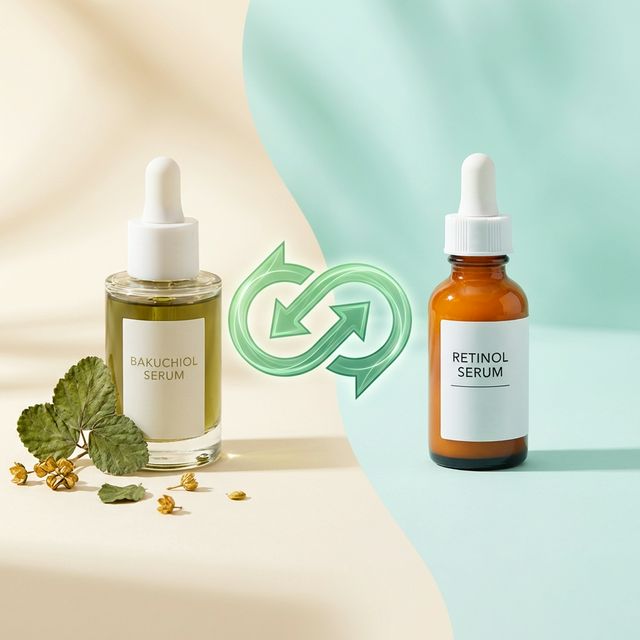
Bakuchiol (pronounced buh-KOO-chee-all) is a meroterpene extracted from the seeds and leaves of the Psoralea corylifolia plant, which has been used in Ayurvedic and traditional Chinese medicine for centuries. It is classified as a functional analog of retinol, meaning it achieves similar biological effects through overlapping gene expression pathways, despite having a completely different chemical structure.
Retinol (vitamin A₁) is the gold-standard anti-aging active ingredient. It stimulates collagen production, accelerates cell turnover, reduces fine lines, and fades pigmentation. However, retinol causes irritation, dryness, peeling, and photosensitivity in many users, especially beginners.
The key difference: bakuchiol delivers retinol-like results without activating the same retinoid receptors that cause side effects. This makes it suitable for sensitive skin, daytime use, and populations who cannot use retinoids.
The Clinical Trial That Changed Everything
Most "natural alternatives" in skincare rely on marketing claims rather than clinical proof. Bakuchiol is the exception. According to Dhaliwal et al. (2019), published in the British Journal of Dermatology (doi:10.1111/bjd.17735), bakuchiol performs comparably to retinol under rigorous scientific conditions.
The Dhaliwal Study Design
This was a prospective, randomized, double-blind study: the most reliable type of clinical trial in dermatology. Here's how it worked:
- 44 participants with facial photoaging
- Group A: 0.5% bakuchiol cream, applied twice daily
- Group B: 0.5% retinol cream, applied once daily
- Duration: 12 weeks
- Measured: wrinkle severity, hyperpigmentation, scaling, stinging
The Results
According to the study's findings, both groups showed statistically significant improvements:
| Outcome | Bakuchiol (0.5%) | Retinol (0.5%) | Difference |
|---|---|---|---|
| Wrinkle reduction | Significant ↓ | Significant ↓ | No significant difference (p > 0.05) |
| Hyperpigmentation | Significant ↓ | Significant ↓ | No significant difference (p > 0.05) |
| Scaling | None reported | Significantly more | Bakuchiol wins |
| Stinging | None reported | Significantly more | Bakuchiol wins |
| Photosensitivity | Not observed | Increased | Bakuchiol wins |
The takeaway: bakuchiol delivered equivalent anti-aging results with significantly better tolerability. No scaling, no stinging, no photosensitivity.
How Bakuchiol Works (The Science)
Bakuchiol's anti-aging mechanism has been studied at the molecular level. According to Chaudhuri and Bojanowski (2014), published in the International Journal of Cosmetic Science (doi:10.1111/ics.12130), bakuchiol modulates gene expression in a manner remarkably similar to retinol.
1. Retinol-Like Gene Expression
DNA microarray studies show that bakuchiol activates many of the same genes as retinol, including genes involved in the retinoic acid receptor (RAR) pathway. According to the research, bakuchiol upregulates:
- Type I, III, and IV collagen, the structural proteins that keep skin firm and plump
- TIMP-1 and TIMP-2, enzymes that prevent collagen breakdown
- Aquaporin-3, the channel protein responsible for skin hydration
2. Antioxidant and Anti-Inflammatory
Unlike retinol, bakuchiol also functions as a direct antioxidant. According to Bluemke et al. (2022) in Skin Pharmacology and Physiology (doi:10.1159/000518261), bakuchiol scavenges reactive oxygen species (ROS) and inhibits MMP-1, the enzyme most responsible for UV-induced collagen degradation.
3. No Retinoid Receptor Binding
Here's the critical difference: bakuchiol does not bind to retinoid receptors (RAR/RXR) the way retinol does. This explains why it avoids retinol's signature side effects (irritation, peeling, and photosensitivity) while still delivering anti-aging results through overlapping downstream pathways.
Bakuchiol vs Retinol: The Complete Comparison
Based on the clinical evidence and SkinGuard's analysis of 28,705 verified substances, here's how bakuchiol and retinol compare across every dimension that matters:
| Factor | Bakuchiol | Retinol |
|---|---|---|
| Source | Plant-derived (Psoralea corylifolia) | Synthetic vitamin A derivative |
| Anti-wrinkle efficacy | Clinically equivalent (Dhaliwal 2019) | Gold standard |
| Irritation | Minimal to none | Common (scaling, peeling, redness) |
| Photostability | Photostable; safe AM + PM | Degrades in sunlight; PM only |
| Pregnancy | No retinoid receptor binding (consult OB-GYN) | Contraindicated (teratogenic risk) |
| Sensitive skin | Well-tolerated | Often causes flare-ups |
| Concentration | Typically 0.5–2% | Typically 0.25–1% |
| Application | 2× daily (AM + PM) | PM only, build up gradually |
| SkinGuard classification | RETINOL_ALT group | RETINOIDS group |
| Interaction | SYNERGY, one of only 2 synergy ratings in SkinGuard | |
Who Should Choose Bakuchiol Over Retinol?
Bakuchiol is not a universal replacement for retinol. But for specific populations, the clinical data strongly supports it as the better choice:
1. Sensitive or Reactive Skin
According to dermatological research, approximately 40–55% of adults report having sensitive skin. For these individuals, retinol's "retinization" period (2–6 weeks of peeling, redness, and tightness) can cause enough discomfort to abandon the ingredient entirely. Bakuchiol bypasses this adjustment period completely.
2. Pregnancy and Breastfeeding
Retinol and all retinoids are contraindicated during pregnancy due to teratogenic risk. According to the American College of Obstetricians and Gynecologists (ACOG), even topical retinoids should be avoided. Bakuchiol does not bind to retinoid receptors and carries no known teratogenic risk, though large-scale pregnancy-specific studies remain limited. Always consult your OB-GYN before introducing any active ingredient during pregnancy.
3. Daytime Anti-Aging Users
Retinol degrades rapidly in UV light, which is why dermatologists universally recommend PM-only application. Bakuchiol is photostable, so it can be applied both morning and night without efficacy loss. This effectively doubles your exposure to anti-aging actives.
4. Retinol Beginners
For users who have never used retinoids, bakuchiol offers a zero-risk entry point to anti-aging skincare. You get measurable results without the learning curve of titrating retinol concentrations and managing side effects.
The Synergy: Using Bakuchiol AND Retinol Together
Here's what most articles miss: bakuchiol and retinol are not just alternatives , they're synergy partners. SkinGuard's conflict engine classifies Bakuchiol × Retinoids as SYNERGY (severity: LOW), one of only 2 synergy classifications out of 18 total rules in the engine.
According to the SkinGuard conflict database, "Bakuchiol may complement retinoids and is often well-tolerated, but patch testing is still recommended for sensitive skin."
Why They Work Better Together
- Complementary pathways: Retinol activates retinoic acid receptors directly; bakuchiol modulates similar genes through different upstream mechanisms. Together, they produce a broader anti-aging effect.
- Buffered side effects: Bakuchiol's anti-inflammatory properties help counteract retinol's irritation potential, reducing scaling and redness during the retinization period.
- Extended coverage: Apply bakuchiol in the AM (photostable) and retinol in the PM (photosensitive). This provides 24-hour anti-aging coverage with no ingredient overlap.
How to Layer the Combination
| Time | Step 1 | Step 2 | Step 3 | Step 4 |
|---|---|---|---|---|
| AM | Cleanser | Bakuchiol serum | Moisturizer | SPF 30+ |
| PM | Cleanser | Retinol serum | Moisturizer | - |
Start with retinol 2–3 nights per week and increase as tolerated. Bakuchiol can be used daily from day one without a titration period.
How to Choose a Good Bakuchiol Product
Not all bakuchiol products are equal. According to formulation science research, these factors determine efficacy:
- Concentration: 0.5–2%, The Dhaliwal study used 0.5%. Higher concentrations (1–2%) are used in some premium formulations for enhanced results.
- Full INCI listing: Look for "Bakuchiol" in the ingredient list. Some products list Psoralea corylifolia seed extract, which may contain bakuchiol at variable concentrations.
- Stability testing: Choose products in opaque or dark glass bottles with airless pumps. While bakuchiol is more photostable than retinol, proper packaging extends shelf life.
- Avoid "bakuchiol complex" blends that dilute the active with cheaper botanicals without specifying the bakuchiol concentration.
SkinGuard's OCR scanner identifies bakuchiol in product ingredient lists and automatically classifies it within the RETINOL_ALT group in its database of 28,705 verified substances, so you can instantly see how it interacts with every other ingredient in your routine.
📚 References
- Dhaliwal S, et al. (2019). "Prospective, randomized, double-blind assessment of topical bakuchiol and retinol for facial photoageing." British Journal of Dermatology. doi:10.1111/bjd.17735
- Chaudhuri RK, Bojanowski K. (2014). "Bakuchiol: a retinol-like functional compound revealed by gene expression profiling and clinically proven to have anti-aging effects." International Journal of Cosmetic Science. doi:10.1111/ics.12130
- Bluemke A, et al. (2022). "Bakuchiol, a plant-based functional analogue of retinol with anti-ageing and anti-acne properties." Skin Pharmacology and Physiology. doi:10.1159/000518261
- SkinGuard Conflict Engine. Rule RULE_17: RETINOIDS × RETINOL_ALT (severity: LOW, type: SYNERGY). Analyzed from 18 evidence-based conflict rules covering 28,705 substances.
- Draelos ZD. (2020). "Novel approach to the treatment of hyperpigmented photodamaged skin: 4% retinol and 0.5% bakuchiol." Journal of Cosmetic Dermatology. doi:10.1111/jocd.13305
Frequently Asked Questions
Is bakuchiol as effective as retinol?
Yes. A 2019 randomized controlled trial in the British Journal of Dermatology found bakuchiol matched retinol for reducing wrinkles and hyperpigmentation over 12 weeks, with significantly less irritation.
Can you use bakuchiol and retinol together?
Yes. SkinGuard classifies Bakuchiol + Retinoids as a SYNERGY, one of only 2 synergy ratings in its entire conflict engine. Bakuchiol can buffer retinol's side effects while both target aging through complementary pathways.
Is bakuchiol safe during pregnancy?
Bakuchiol is not a retinoid and does not bind to retinoid receptors, which is why it lacks the teratogenic risk of retinol. However, large-scale pregnancy studies are limited. Consult your OB-GYN before use.
Can I use bakuchiol in the morning?
Yes. Unlike retinol, bakuchiol is photostable and does not degrade in sunlight. You can apply it morning and night. Still use SPF 30+ daily regardless of which active you use.
Does SkinGuard detect bakuchiol in product scans?
Yes. SkinGuard identifies bakuchiol (INCI: Bakuchiol) in its database of 28,705 verified substances and classifies it in the RETINOL_ALT group, flagging it as a synergy partner for retinoids, not a conflict.
⚕️ This article is for educational purposes only and is not medical advice. It is not a substitute for professional dermatological consultation. If you experience persistent skin irritation from any product combination, consult a board-certified dermatologist. Pregnant or breastfeeding individuals should consult their healthcare provider before using any new skincare active.
Last updated: February 24, 2026 · Reviewed by the SkinGuard Science Team