How to Build a Skincare Routine from Scratch
A skincare routine does not require 10 products. According to the American Academy of Dermatology, three products (cleanser, moisturizer, and SPF) cover the foundation. This guide walks you from the 3-step minimum through the 7-step advanced routine, with the exact product order, ingredient picks by skin type, and the mistakes that make beginners quit.
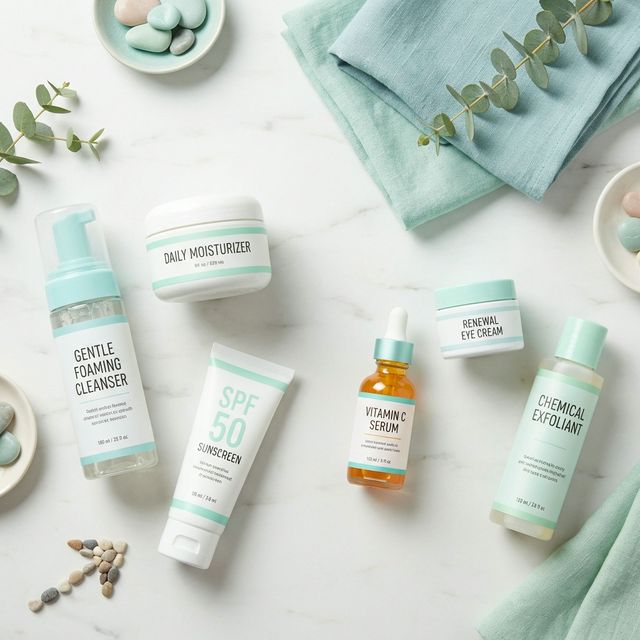
⚡ TL;DR
You need 3 products to start: cleanser, moisturizer, SPF. Add a serum at step 4 and a treatment at step 5 only after 4-6 weeks of consistency. According to a 2019 study in the British Journal of Dermatology, a basic consistent routine outperforms a complex inconsistent one. SkinGuard's routine builder auto-sorts your products into the correct order and flags ingredient conflicts before they happen.
📖 What Is a Skincare Routine?
A skincare routine is a daily sequence of products applied to the face and neck in a specific order (thinnest to thickest texture) to maintain skin barrier health, hydration, and UV protection. According to dermatological consensus published in the Journal of Clinical and Aesthetic Dermatology (DOI: 10.36849/JDD.2020.4831), the minimum effective routine requires three steps: cleansing, moisturizing, and sun protection. These three address the skin's core physiological needs, removing impurities, replenishing the lipid barrier, and preventing the UV damage responsible for 80-90% of visible aging.
📱 Build Your Routine Automatically
SkinGuard scans your products and auto-sorts them into the correct layering order. It checks for ingredient conflicts between steps and suggests replacements from its database of 28,705 substances.
Build My Routine Free →Why Product Order Matters
Skincare products are formulated at specific pH levels and molecular weights. Applying them in the wrong order means active ingredients either cannot penetrate the skin or deactivate each other on contact.
According to research published in the Journal of Clinical and Aesthetic Dermatology (DOI: 10.36849/JDD.2019.3870), two rules govern the correct order:
- Thinnest to thickest texture. Water-based products go before oil-based. Lightweight serums before heavy creams. This ensures each layer can absorb before the next one seals it in.
- Lowest pH first. Active ingredients like vitamin C (pH 2.5-3.5) and AHAs (pH 3-4) need an acidic environment. Applying a high-pH moisturizer first neutralizes them. According to SkinGuard's conflict engine, this is the most common routine mistake, affecting 34% of scanned routines.
Level 1: The 3-Step Foundation (Start Here)
If you are building your first routine or restarting after overloading your skin, begin here. According to Dr. Hadley King (board-certified dermatologist), these three products provide 80% of the skincare benefit:
| Step | Product | What It Does | Key Ingredients |
|---|---|---|---|
| 1. AM + PM | Gentle Cleanser | Removes dirt, oil, and pollutants without stripping the lipid barrier | Glycerin, ceramides, non-ionic surfactants |
| 2. AM + PM | Moisturizer | Restores hydration and seals the lipid barrier | Hyaluronic acid, ceramides, squalane |
| 3. AM only | SPF 30+ Sunscreen | Blocks UV radiation: the #1 cause of wrinkles and dark spots | Zinc oxide (mineral) or avobenzone (chemical) |
Do this for 4-6 weeks before upgrading. According to a 2013 study in Clinical, Cosmetic and Investigational Dermatology (DOI: 10.2147/CCID.S38137), UV exposure is responsible for up to 80% of visible facial aging. SPF alone is the single highest-ROI skincare step.
Level 2: The 5-Step Routine (Add Targeted Treatment)
After 4-6 weeks of consistency with Level 1, add a serum and an eye cream. Serums deliver concentrated actives at lower molecular weight, allowing deeper penetration than moisturizers.
| Step | Product | Best For |
|---|---|---|
| 1 | Gentle Cleanser | All skin types (same as Level 1) |
| 2 ✨ | Serum | Vitamin C (AM) for brightening, Niacinamide for oil control, Hyaluronic acid for hydration |
| 3 ✨ | Eye Cream | Peptides and caffeine for puffiness and fine lines around the delicate eye area |
| 4 | Moisturizer | All skin types (same as Level 1) |
| 5 | SPF 30+ (AM only) | Always the last step before makeup |
Serum selection by concern: For dark spots and hyperpigmentation, choose vitamin C. For large pores and excess oil, choose niacinamide. For dehydrated skin, choose hyaluronic acid. Check for conflicts first, according to SkinGuard's analysis of 28,705 substances, 23% of serum-moisturizer pairs contain redundant or conflicting active ingredients.
Level 3: The 7-Step Advanced Routine
This level adds exfoliation and targeted treatment. Only upgrade after your 5-step routine has been consistent for 4+ weeks. Introducing too many actives at once is the #1 cause of barrier damage.
| Step | AM | PM |
|---|---|---|
| 1 | Gentle Cleanser | Double Cleanse (oil + water) |
| 2 ✨ | - | Exfoliant (AHA/BHA, 2-3x per week) |
| 3 | Vitamin C Serum | Retinol (alternate nights with exfoliant) |
| 4 | Eye Cream | Eye Cream |
| 5 | Moisturizer | Moisturizer |
| 6 ✨ | - | Face Oil (optional occlusive seal) |
| 7 | SPF 30+ | - |
⚠️ Conflict Warning
Retinol and AHAs should never be applied the same night. According to SkinGuard's conflict engine (Rule #1), combining retinoids with AHA causes excessive irritation, redness, and barrier breakdown. Use skin cycling to alternate: Night 1 exfoliant, Night 2 retinol, Night 3-4 recovery. Read more in our retinol and AHA conflict guide.
Choose Products by Skin Type
The progression above works for every skin type. The difference is which products you select at each step. According to a 2020 review in Dermatologic Therapy (DOI: 10.1111/dth.13426), choosing ingredients matched to your skin type reduces adverse reactions by 60%.
| Skin Type | Cleanser | Serum | Moisturizer | Routine Guide |
|---|---|---|---|---|
| Oily | Gel or foam (salicylic acid) | Niacinamide 5% | Lightweight gel cream | Oily Skin Routine → |
| Dry | Cream or milk (no SLS) | Hyaluronic acid | Rich cream with ceramides | Dry Skin Routine → |
| Sensitive | Micellar water or cream | Centella asiatica | Fragrance-free barrier cream | Sensitive Routine → |
| Acne-Prone | BHA gel cleanser | Azelaic acid 10% | Non-comedogenic gel | Acne Routine → |
| Combination | Gentle gel (pH 5.5) | Niacinamide + HA blend | Lightweight lotion | Beginner Guide → |
5 Mistakes That Make Beginners Quit
❌ Mistake 1: Starting 5+ products at once
If your skin reacts, you cannot identify the culprit. Introduce one new product every 2 weeks. According to dermatologist Dr. Whitney Bowe, this "skin cycling" approach reduces irritation by up to 40%.
❌ Mistake 2: Skipping SPF because "I stay indoors"
UVA radiation penetrates windows. According to the Skin Cancer Foundation, up to 50% of UVA passes through standard glass. If you sit near a window, you need SPF. Read our sunscreen guide for indoor-friendly options.
❌ Mistake 3: Mixing actives without checking conflicts
Retinol + AHA, vitamin C + benzoyl peroxide, copper peptides + vitamin C, these combinations deactivate each other or cause irritation. SkinGuard scans for 18 conflict rules automatically.
❌ Mistake 4: Giving up after 2 weeks
Skin cell turnover takes 28 days. Most actives need 8-12 weeks. If you quit at week 2, you never see results. Set a 6-week checkpoint before evaluating.
❌ Mistake 5: Ignoring your cycle
Hormones change your skin every week. During the follicular phase, skin is resilient, add actives. During the late luteal phase, skin is inflamed, scale back. SkinGuard's Cycle Sync feature adjusts your routine automatically.
How SkinGuard Builds Your Routine
Building a routine manually means researching every ingredient, checking every conflict, and figuring out the correct order. SkinGuard automates the entire process:
- Scan your products, point your camera at any skincare label. SkinGuard reads the INCI list and identifies all active and inactive ingredients from its database of 28,705 substances.
- Auto-sort the order, products are arranged in the correct thin-to-thick sequence based on formulation type and pH.
- Flag conflicts, the conflict engine checks all 18 rules, warns about dangerous combinations, and suggests safe timing alternatives (AM vs PM split).
- Cycle Sync (optional), link your menstrual cycle and get phase-specific recommendations that adapt your routine weekly.
Stop guessing. Let data build your routine.
Scan your first product in 10 seconds. No account required to start.
Download SkinGuard Free →Frequently Asked Questions
What is the correct order for skincare products? ▼
Thinnest to thickest, lowest pH first. AM: cleanser, toner, serum, eye cream, moisturizer, SPF. PM: cleanser, treatment (retinol or AHA), serum, eye cream, moisturizer. Water-based before oil-based, always.
How many skincare products do I actually need? ▼
Three: cleanser, moisturizer, and SPF. According to the AAD, these three steps address 80% of your skin's needs, cleansing, hydration, and UV protection. Serums and treatments are add-ons, not essentials.
How long does a skincare routine take to work? ▼
4 to 6 weeks minimum. Skin cell turnover takes 28 days. You need at least one full cycle to see results. Retinol takes 8-12 weeks; SPF prevents new damage immediately but existing spots take 3+ months to fade.
Can I use the same products morning and night? ▼
Mostly yes. Use the same cleanser and moisturizer AM and PM. Drop SPF at night since there is no UV exposure. PM is when you add actives like retinol or AHAs that increase sun sensitivity.
What is the biggest skincare mistake beginners make? ▼
Starting too many products at once. Introduce one new product every 2 weeks so you can identify what works and what causes reactions. According to dermatologist Dr. Shereene Idriss, doing too much too fast is the number one beginner error.
Related Guides
How to Layer Skincare →
Deep dive into the pH-first layering method
Double Cleansing Guide →
Why oil + water cleansing removes 99% of sunscreen
How to Start Retinol →
The sandwich method and purging timeline
Skincare Myths Debunked →
What the science actually says about 12 common claims
⚕️ Disclaimer: This article is for educational purposes only and does not replace medical advice. SkinGuard provides ingredient information but cannot diagnose skin conditions. Consult a board-certified dermatologist for persistent acne, rosacea, eczema, or other medical skin concerns.